

Kanchenjunga Trek
Nepal, Less Crowded Treks Nepal, Challenging Treks In Nepal, High Pass Trekking In Nepal




Start From
$ 1900 USD per person
Number of Travellers
Overview
Kanchenjunga Trek is one of the Longest and Challenging Himalaya treks in Nepal. The trek is a perfect opportunity to explore the untouched and unspoiled highland wilderness. During the Kanchenjunga Trek, you will reach North and south Kanchenjunga Base Camp via several high passes.
Trekking to Kanchenjunga Circuit takes you to Kanchenjuga base camp through diverse landscapes, from lush subtropical forests to rugged alpine terrain. Along the way, you’ll encounter a variety of ethnic communities, including Rai, Limbu, and Bhutia, and have the opportunity to observe their unique cultures and lifestyles. The trek also offers stunning views of the Kanchenjunga massif, as well as other peaks such as Jannu, Kabru, and Rathong.
It’s important to note that this trek is not recommended for beginner trekkers, it requires a high level of physical fitness . and also to be prepared for extreme weather conditions and to have a proper gear. It’s essential to use the service of a professional guide or trekking agency.
Kanchenjunga Base Camp Trek Routes
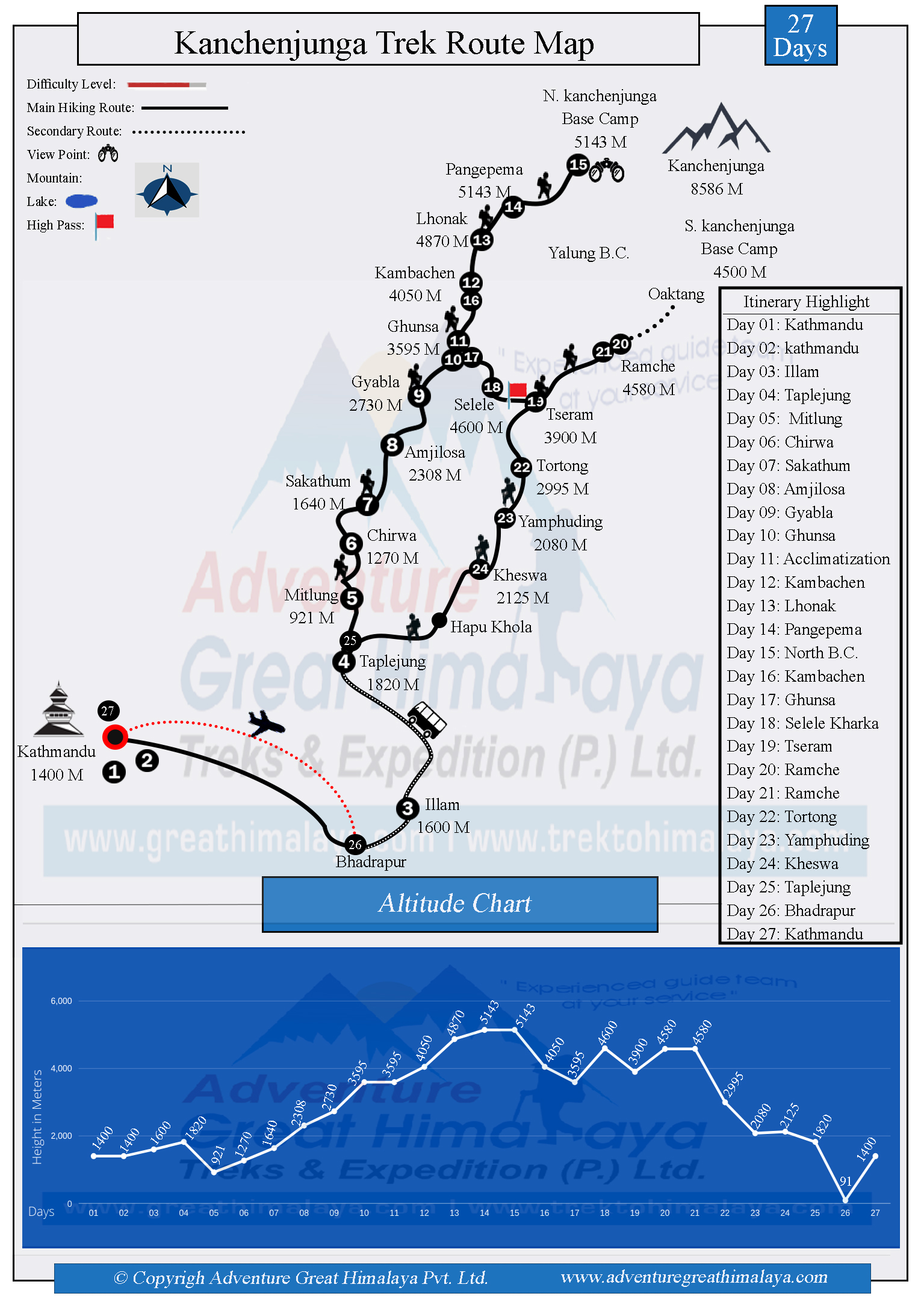
The Kanchenjunga Base Camp Trek Journey is an isolated trek situated in the north-eastern part of Nepal. The trek begins with a short flight to Bhadrapur. From there we will drive to Ilam and then to Taplejung.Taplejung is the point where you begin your actual trek. We trek through Taplejung, Mitlung, Chiruwa, Sakathum, Amjilassa, Gyabla, Gunsa, Khambachen, Lhonak, and finally to the Northern Base Camp of Kanchenjunga.
From the Northern Kanchenjunga base camp, we will trek through Khambachen and back to Gunsa. After crossing Tseram, we will move through Ramche from the Southern Base Camp of Kanchenjunga. The hiking trails back to Torntan, Yamphudin, Kheswa, and to Taplejung. From Taplejung, we’ll drive to Bhadrapur and fly to Kathmandu from there.
The Kanchenjunga massif displays wonderful and exotic views of snow giants above and below 8000 meters. You can see Mt. Kanchenjunga, Mt. Everest, Mt. Lhotse, and many other peaks during the Kanchenjunga circuit trek.
You can enjoy the amazing landscapes and topography during Kanchenjunga trek. The trek is full of alpine grasslands, sub-tropical forests and low river valleys. Walking across beautiful waterfalls, thickets of rhododendron and amazing mountain vistas is a great feeling.
The trek passes through Kanchenjunga Conservation Area that houses diverse species of flora and fauna. There are chances of seeing wildlife such as Snow Leopard, Musk deer, Red Panda, etc while trekking. You might also see some threatened species of birds like Impedance Pheasant and Red-billed blue magpie.
While trekking, you will see the amazing valleys and traditional villages. The local people are hospitable. The isolated communities are not affected by modernity. You will see the diverse local groups preserve their amazing culture and traditions.
Expected Tea House / Camp Accommodation
Kanchenjunga trek is a combination of tea house and camp trekking. At places like Lhonak, Northern Base Camp, Khambachen, Gunsa, Selele Kharka, Tseram you should stay in your tents for overnights. Whereas in other places, there are lodges and teahouses for stays.
The tea houses In this route aren’t well facilitated. They provide basic facilities for foods and stays. Food and accommodation are expensive than in other treks due to remoteness of the place. Carry extra hand cash to pay for extra services like hot shower, wifi, extra blankets, etc.
Why Trek to Kanchenjunga Trek?
- Mount Kanchenjunga 8586 meters, the third highest peak in the world
- The blend of traditional Nepali and Tibetan culture
- Wild, remote, and unspoiled nature including amazing landscapes, forests, rivers and waterfalls
- Exploring around the northern and southern base camp of Mt. Kanchenjunga
- Crossing the several Glacier. Such as Kanchenjunga glacier, Yalung Glacier and many others
- Crossing the Numbers of High passes Such as Sele La pass (4290 meters), Mirginla Pass (4480 meters) and Sinelapcha Pass 4646,
- Remote picturesque villages and the local ethnic groups
- The Kanchenjunga Conservation Area, diverse wildlife such as Snow leopard, Musk deer, Red panda, etc.
Kanchenjunga Trek Itinerary
Arrival in Kathmandu transfers to hotel. (1300m )
Your arrival at the Tribhuvan International Airport marks the start of the Kanchenjunga Base Camp Trek. At the airport, you will get picked up by the team members and then taken to the hotel. The beautiful city of Kathmandu is where you can explore in the evening. In the hotel, you will get briefed by the team about the trekking journey that lies ahead. You can rest at the hotel in Kathmandu for the night.
Meals :- Dinner
Transportation: Airport Pick up
Accommodation: 3 Star Hotel
Trekking preparation day- buy or rent your personal equipment obtain permit for the trek etc.
The second day is separated for preparation. You can go on to shops around Thamel on this day to buy or rent your trekking gear and equipment for the trek. Besides that, you can also obtain the necessary permits required for the tour from Nepal Tourism Board’s Office. After completing all the necessary preparation, you can rest in the hotel in the evening.
Meals :- Breakfast,
Accommodation: 3 Star Hotel
Flight from Kathmandu to Bhadrapur, Drive to Birtamod (jeep/taxi), again Drive to Taplejung (1441 m)
Flight Duration: 45 minutes
Bhadrapur to Birtamod Drive duration: 45 minutes
Taplejung altitude: 1441m
Birtamod to Taplejung Drive duration: 8 hours
Overnight: Taplejung
The flight in the early morning takes you to Bhadrapur from Kathmandu. You will arrive at the settlements of Bhadrapur after a flight of around 45 minutes. From there, you will then go on a drive to Birtamod in a jeep or taxi. After arriving at Birtamod, you will take an incredible highway drive for 6-7 hours on a local bus passing through the region’s scenic landscapes to Taplejung.
Meals :- Breakfast, Lunch , Dinner
Transportation: Flight / Private Jeep
Accommodation: Guest House
Drive to Sekhathum ( 5-6 hour drive)
Sakathum altitude: 1640m
Drive duration: 6 hours
Overnight: Sakathum
On this day, you will take another jeep drive to Sakathum. The beautiful trails take you through the serene natural terrains of the hilly region. You will arrive at your destination after 6 hours, where you will rest for the night.
Meals :- Breakfast, Lunch , Dinner
Transportation: Sharing Jeep
Accommodation: Lodge
Trek to Amjilassa (2490m) 6 hour
Trek duration: 5 hours
Amjilosa altitude: 2310 m
Overnight: Amjilosa
The trekking journey begins from the village settlement of Sakathum. From there, you will continue your journey passing through the numerous terrains of the region to arrive at Amjilosa. The trail gradually begins on a flat path before continuing the uphill terrain through colorful forests alongside the Tamar River.
You can observe the serene Himalayan vista along the route. There are many waterfalls and streams along the trail as well. After arriving at Jabari, you will rest for some time before continuing the trek. After trekking for a few hours, you will reach the day’s destination, Amjilosa.
Meals :- Breakfast, Lunch , Dinner
Accommodation: Guest House
Trek to Gyabla (2730m) 6 hour
Trek duration: 6 hours
Gyabla altitude: 2725 m
Overnight: Gyabla
On this day of the trek, you will continue your walk in the region from Amjilosa. You will trek to Gyabla on this day of the tour at an altitude of 2730m. The trail will lead alongside the Ghunsa Khola. The track moves uphill above a ridge and crosses the Ghunsa Khola on a wooden bridge.
There are many bamboo bushes you will have to climb through, providing the serene lakes of the region. There are switchback paths on an uphill valley and rocky terrain. Trekkers need to be wary of the landslide-prone area during the trail. After reaching Gyabla, you will rest for the night in the teahouse.
Meals :- Breakfast, Lunch , Dinner
Accommodation: Tea House
Trek to Gunsa (3410m) 6 hour
Trek duration: 5 hours
Ghunsa altitude: 3400 m
Overnight: Ghunsa
The section of the Kanchenjunga base camp trek from Gyabla to Ghunsa leads you through a narrow valley. The trekkers will trek alongside the Ghunsa Khola, passing through the diverse vegetation. Trekkers will climb gradually along the trail to arrive at a forested path with rhododendrons and bamboo trees.
There are also tricky landslide-prone areas that you will cross to arrive at the settlement of Phale. It is a winter destination for people migrating from Ghunsa. After an uphill hike for a few hours, you will reach the settlement of Ghunsa. You can find a large community of Sherpas, and you will rest overnight.
Meals :- Breakfast, Lunch , Dinner
Accommodation: Tea House
Trek to Khambachen (4150m) 5 hour
Trek duration: 5 hours
Khambachen altitude: 4100m
Overnight: Khambachen
On this day, the trek to Khambachen from Ghunsa is challenging as there are many rockfall areas along the trail. The trails of the hike will take you through the beautiful river banks, with many forested areas of rhododendron and pine trees.
After crossing a few wooden bridges, you will arrive at the settlement of Rampuk Kharka. There are many landline areas that you need to cross. The beautiful views of cascading waterfalls will enchant you along the trail. From this viewpoint, you can also observe Mt. Jannu. After arriving at Khambachen, you will rest at the teahouse.
Meals :- Breakfast, Lunch , Dinner
Accommodation: Tea House
Acclimatization and exploration at Khambachen - visit Mount Kumbhakarna/Mt Jannu viewpoint (4400m)
Hike duration: 5-6 hours
Overnight: Khamachen
This is the point of the trek where you will stop for acclimatization, as it is essential. You will explore Khambachen on this day. There is also a viewpoint of Kumbhakarna/Mt Jannu, which you can visit in your acclimatization journey. You can go on a lengthy hike to a nearby hill as well. Overall, exploring the region takes around 5-6 hours, and you will return to Khambachen.
Meals :- Breakfast, Lunch , Dinner
Accommodation: Tea House
10. Trek to Lhonak(4790m) 3 Hour
Trek duration: 3 hours
Lhonak altitude: 4780 m
Overnight: Lhonak
On this trek section, you will trek from Khambachen to Lhonak. This scenic section of the trek is quite challenging as well. The beautiful trail has many rocky fields and boulders. Trekkers will take on a descending path alongside the river’s banks. You will also cross the water streams on a bridge.
After climbing for some time, you will reach the magnificent Ramtang Monastery. You can visit the Gompa and experience the spiritual atmosphere of the Gompa. The trail finally takes you to the destination of Lhonak. There, you will rest overnight at a local lodge or teahouse.
Meals :- Breakfast, Lunch , Dinner
Accommodation: Tea House
Hike to Kanchenjunga North Base Camp (Pang Pema) (5140 m), Return to Lhonak
Trek duration: 6-7 hours
Kanchenjunga North Base Camp altitude (Pang Pema): 5140 m
Overnight: Lhonak
The trail on this trek section will take you to the ultimate destination of the Kanchenjunga north base camp, also known as the Pang Pema base camp. The beautiful trail will take you through the serene terrains of the Kanchenjunga region.
The Kanchenjunga north base camp starts on this day. The trail will lead you through the beautiful terrains of the region. The uphill path will guide you through areas with many rhododendrons and other wildflowers. Trekkers on this trail need to pass through the Kanchenjunga glacier.
Meals :- Breakfast, Lunch , Dinner
Accommodation: Tea House
Trek to Gunsa (3410m) 7 Hour
Trek duration: 5 hours
Kambachen altitude: 4110m
Overnight: Gunsa
The trail from Lhonak to Gunsa is filled with immense flora and fauna. You will get to observe the green trails with the scenic vista of the region. The steep trails will then take you through the diverse terrains of the region.
You will explore the beautiful trails with many flora and fauna of the region. The beautiful trails of the region will lead you through the picturesque yak pastures. You will get a different perspective of the region. You will trek for around 4-6 hours to arrive at the destination of Khambachen.
From the settlement of Khambachcen, you will trek to the beautiful destination of Ghunsa. The trail then takes you through the downhill path, which is relatively easy. You can rest and stay overnight at Ghunsa.
Meals :- Breakfast, Lunch , Dinner
Accommodation: Tea House
Trek to Selele Base Camo ( 4300m) 6 hour
Trek duration: 5 hours
Sele La Kharka: 4200 m
Overnight: Sele Base Camp
The trail from Ghunsa to Sele la Base Camp is quite an exciting trail with a stunning vista of the region. The beautiful course will lead you through the serene terrains where you can observe the diverse natural landscapes.
You will travel through the beautiful terrains to reach the South Selela Base Camp. You will love to trek the incredible trails with a scenic vista. From the base camp, you can observe the snow-clad mountains. You will camp for the night at the base camp.
Meals :- Breakfast, Lunch , Dinner
Accommodation: Tea House
Trek from Selela Base Camp to Selele Pass, trek down to Tseram (3900m)
Trek duration: 6 hours
Selela pass altitude: 3870 m
Overnight: Tseram
The trail on this section of the trek is quite daunting as you will pass through the beautiful Selela pass to arrive at Tseram. The trail to Selela La Pass is uphill and challenging. You will get the stunning vista of Mt. Kanchenjunga and other snow-clad mountains from Sele La Pass. You will then descend around 1000m to Tseram after exploring the beautiful landscapes of the mountain pass.
Meals :- Breakfast, Lunch , Dinner
Accommodation: Tea House
Trek from Tseram to Ramche (4620m) -Visit Yalung (4500m) and South Base Camp (4620m)/ Oktang, and return to Ramche.
Trek duration: 8-9 hours
Yalung base camp: 4500m
South base camp/Oktang: 4620m
Overnight: Ramche
You will climb uphill on a gradual path to arrive at your destination of Ramche. There are excellent viewpoints to observe the snow-clad mountains of the region. You can visit the Yalung Base Camp and the Oktang Base Camp, also known as the south base camp.
The base camps provide you with a unique experience and spectacular vista. There are snow clad mountains all around that you can capture in your camera. After exploring around for some time, you will traverse through the lateral moraines of the region. After trekking for a few hours, you will arrive at the destination of Ramche.
Meals :- Breakfast, Lunch , Dinner
Accommodation: Tea House
Trek from Ramche to Torontan (2990m)
Trek duration: 7 hours
Ramche altitude: 4730 m
Overnight: Torontan
The trail on this section of the trek will take you from Ramche to Torontan. Trekkers will pass through the alpine valley, lateral moraines, and Yalung Glacier to arrive at Oktang Base Camp.
The snow-clad mountains look stunning along the route. You will then descend the trail from the base camp. You will arrive at the destination of Torontan. The course will take around 3-4 hours to arrive at the destination.
Meals :- Breakfast, Lunch , Dinner
Accommodation: Tea House
Trek from Torontan to Yamphudin (1690m)
Trek duration: 5 hours
Torangden altitude: 2200 m
Overnight: Yamphudin
The trail will lead you through the descending path to arrive at Yamphudin. The 5-6 hours trek will take you alongside the Simbuwa Khola. There are many natural terrains with rhododendron, pine, and orchid trees of the Kanchenjunga Conservation Area on the route to Yamphudin.
Meals :- Breakfast, Lunch , Dinner
Accommodation: Tea House
Trek from Yamphudin to Khebang (2125 m)
Trek duration: 5 hours
Yamphudin altitude: 2200 m
Overnight: Khebang
The beautiful trek from the incredible terrain will lead through the fantastic landscapes of the Yamphudin to Khebang. After passing through the serene terrains of the region to arrive at the settlement of the Lamite Bhanjyang.
The trail descends gradually through the pine-forested area and crosses the Simbhua Khola. The course will lead you through the Amji Khola river banks you will cross in the region. You will trek for 6-7 hours before arriving at Khebang.
Meals :- Breakfast, Lunch , Dinner
Accommodation: Tea House
Khebang Drive to kanyam , Ilam -7 hour
Trek duration: 5 hours
Khebang altitude: 1800 m
Overnight: Kanyam
The trail on this day takes you through the beautiful green tea hills to arrive at the destination of Kanyam in Ilam. The beautiful course will pass through the region’s incredible terrain and the area’s highway. You will arrive at the destination of Ilam after 3-4 hours, where you will rest in the teahouse.
Meals :- Breakfast, Lunch , Dinner
Accommodation: Guest House
Drive to Bhadrapur / fly back Kathmandu
Flight duration: 45 minutes
Drive duration: 5-6 hrs
Overnight: Kathmandu
On this day, you will drive from Kanyam in Ilam to Bhadrapur, which takes around 3-4 hours. You will then fly to Kathmandu from the airport on Bhadrapur on a flight journey. It takes 15-20 minutes to arrive at Tribhuvan International Airport in Kathmandu.
Meals :- Breakfast,
Accommodation: Hotel
Departure from Nepal.
On this trekking day, you will fly from the Tribhuvan International airport in Kathmandu to your destination back home.
Meals: Breakfast
Cost Include/Exclude
What’s include
- Airport/ Hotel/ Airport Transportation.
- Three Nights 3 Star hotel in Kathmandu including breakfast included.
- 3 Meals a day during the trek ( Breakfast, Lunch, dinner)
- Hot Drinks – Tea / Coffee
- Lodge/ Tea house Accommodation during the trek.
- A government licensed English speaking Guide during the trek.
- Trekking porter ( One porter for every two members) the limit weight is 20-25 Kg)
- All special trekking permits & fees.
- Flight Ticket from Kathmandu – Bhdrapur – Kathmandu including airport departure taxes in both airport.
- Ground Transportation by Car / Jeep
- Trekking Equipment provide, Down Jacket and sleeping bag (which needs to be returned after the trek.)
- All our government taxes.
- Tourist service charge, vat.
- Official expense.
What’s excluded
- Lunch and dinner whilst in Kathmandu.
- Your travel insurance (compulsory).
- International airfare and Nepal Entry Visa
- Items of a personal nature such as alcoholic drinks, cold drinks, laundry.
- Tips
More Info
Best Season for Kanchenjunga Base Camp Trek
Autumn (September, October, and November) and Spring (March, April, and May) are the best time for Kanchenjunga trek. This time is perfect for trekking, touring, and mountaineering in Nepal.
Weather in the Kanchenjunga region mostly remains stable and clear during these times. During the best time, there are least chances of rainfall, snows, or bad climate. The beautiful weather enhances beautiful and unobstructed views of the distant surrounding vistas. The temperature is also moderate which is suitable for trekking.
Kanchenjunga Trek is possible in any time of the year. However Summer (June, July, and August) and Winter (December, January, and February) are less popular seasons to trek. Summer receives heavy monsoon rain in Kanchenjunga region. Winter is colder with freezing temperatures at nights.
How Difficult is the Kanchenjunga Trekking ?
This is a high altitude trek with higher risks of altitude sickness. You will trek up to an altitude of 5143 meters at the Kanchenjunga base camp.
This trek is a longer trek above 22 days trek. Trekking in the entirely isolated trekking trail far from modernity can be difficult. There are some trekkers who feel exhausted in the middle of the trek. Make sure you can do it before you choose to trek.
Trekkers must walk for 6 to 7 hours a day on average during the trek. Walking for such long hours over rugged and different terrain is difficult for beginners. Practice some exercises and strength training starting a month before you go.
Inadequate gear might bring difficulties to your trek. So, get information on packing lists before trekking to Kanchenjunga. Pack what is mandatory. Remember! You’ll need gear for camping also.
This is a high altitude trek with uncertain weather and climatic variations. Be prepared to encounter any sorts of weather changes while trekking.
People & Culture While Kanchenjunga Circuit Trek
Kanchenjunga Trek traverses through the heart of Kanchenjunga region in the eastern vicinity of Nepal. This region is majorly inhabited by 3 group of people
The Limbus :
Limbu people are one of the region’s biggest ethnic groups of eastern Nepal. They are known for their hospitality and are often referred to as the “guardians of the eastern Himalayas”. Limbu people celebrate “Chasok Tangnam” as their main festival which falls on the full moon day in the month of November or December.
The Sherpas:
Sherpas are another ethnic group that are well-known for their mountaineering abilities and have been guiding climbers to the summit of Everest for decades.. They are inhabited in the Kanchenjunga region sparsely. Sherpas celebrate “Manirimdu” as their main festival which usually falls on October every year.
The Rais:
Rai people are indigenous to Nepal, and they are known for their traditional farming and crafts. They are skilled at making handicrafts. Rais inhabit the major portion of North Easter region of Nepal and same is the case with Kanchenjunga region. Rais celebrate “Sakela” as their main festival which falls on April/May month of Gregorian calendar.
Available For Meals / Accommodation
Kanchenjunga Treks traverses through some of the remotest terrain in the Eastern Nepal. This region is limited by road access and it is a cumbersome job to transport food supplies up into the region.
The tea houses along the Kanchenjunga trek serves Nepalese and Tibetan dishes.Most tea houses in the region serves typical Nepali Dish: Daal Bhaat ( Rice and Lentil Soup), this dish is served alongside vegetable curry and pickle.
Modern tea houses in the lower stretches of the trek also provide western version of Nepalese dishes like pies, pasta, french fries, momos and others. Soups, Noodles, Potatoes, Rice and Vegetables are available all across the trail in the tea houses. You can consult your trekking company in advance if there are any special meal requests that differs from the one provided in your trekking package
Trip Map
Frequently Asked Questions
General FAQs
What is the Kanchenjunga Trek?
Kanchenjunga trek is a remote destination that takes you to the base camp of the third-highest mountain in the world. It is a trek that leads you to both North Base Camp (5,143m) and the South Base Camp (4,500m) and is known for its wilderness, culture, and untouched trails.
Where is Kanchenjunga located?
Kangchenjunga is located in far eastern Nepal, near the border of Sikkim, India. Situated inside the Kanchenjunga Conservation Area in Taplejung district, the CA also borders with Tibet, China. The area is well-known for rugged terrain, distant villages, and wildlife. Moreover, the mountain is regarded as one of the most beautiful and unexplored regions of the Himalayas.
How long is the Kanchenjunga Base Camp Trek?
Kanchenjunga Base Camp Trek take you 17, 18 days , starting from Kathmandu and End to kathamndu , The trek will be 21-day-long trek organized by Adventure Great Himalaya. The trekking period actually varies (can reach 26 days), depending on how the itinerary is planned. You can even reduce the trekking days by removing the North Base Camp or the South Base Camp and only opt for one. But be sure not to remove acclimatization days!
What are the main highlights of the Kanchenjunga Trek?
The main highlights of Kanchenjunga treks include:
- Close-up view of the mighty peaks of Mount Kanchenjunga, Jannu, and Yalung Kang.
- Rhododendron forests, meadows, glaciers, and villages within the Kanchenjunga Conservation Area.
- Visit the iconic North and South Base Camps of the third-highest mountain in the world.
Trek through the beautiful landscapes and culturally rich region of Limbus and Rais.
Is Kanchenjunga Trek less crowded than Everest and Annapurna?
Yes, the Kanchenjunga Trek route is significantly less crowded compared to the Everest and Annapurna region treks. The main reason is due to the remote location, few accommodation options, and the requirement of a restricted area permit. Honestly, it’s a challenge more than the serene experience the Kanchenjunga region offers.
How Challenging is the Kanchenjunga Circuit Trek?
The Kanchenjunga trek is often considered challenging and difficult, demanding high-altitude trekking experience, good physical health, and mental resilience. However, with proper training prior to the trek and guidance from your guide, it can be manageable for experienced trekkers.
The Kanchenjunga Conservation Area Project Entry Permit (KCAP) usually costs NRs 2,000 per person, and the Kanchenjunga Restricted Area Permit (RAP) costs around USD 10 per person per week (approx.).
Is the Kanchenjunga Trek suitable for beginners?
Kanchenjunga Trek includes long days of trekking, crossing high altitudes above 5,000 meters, and extremely rugged trails. For that reason, it is going to be a difficult trek for beginners and mostly suitable for intermediate/advanced trekkers. However, with support from Adventure Great Himalaya, combined with your training (for more than a month prior), it is still possible!
What is the maximum altitude of the Kanchenjunga Circuit Trek?
The maximum altitude of the Kanchenjunga Circuit Trek is 5,143m at Pangpema (Kanchenjunga North Base Camp). The South Base Camp (Oktang) is about 4,500m, more than 600m below. So, acclimatization becomes essential, as there is an extreme risk of altitude sickness (usually above 3,000m). Hence, rest days are recommended (which is included on Day 9 in our itinerary)
Is Kanchenjunga Trek better than Everest Base Camp?
It depends on what you really mean by ‘better’. The Kanchenjunga Trek is better if you want less crows, more remoteness, less commercialisation, and more cultural authenticity. However, the Everest Base Camp trek is undoubtedly better if you want a comparatively shorter trek, more convenience, comfort, and a glimpse of the majestic Mount Everest, the tallest in the world.
Why choose Kanchenjunga Circuit Trek over other treks in Nepal?
You should choose Kanchenjunga Trek over other treks in Nepal for a number of reasons. One of which is that it is one of the least explored trekking trails, offering serene routes, pristine nature, and very low trekker traffic. Also, it’s perfect for adventure and peace seekers who want to enjoy wonderful mountain views and village life.
How remote is the Kanchenjunga Trekking?
The Kanchenjunga Trek is in an extremely remote part of eastern Nepal that has limited teahouses and facilities available along its route. The trek begins with a long access route from the town of Taplejung, which requires a flight from Kathmandu, along with multiple drives just to reach. Besides limited road access, even communication and medical facilities are limited here.
Do I need prior trekking experience for Kanchenjunga Trek?
Yes, a prior trekking experience is highly recommended before taking on the Kanchenjunga Trek challenge because it’s a long and physically/mentally demanding journey. You shall have to hike in remote section with limited facilities, a big test to your stamina too. Moreover, the limited accommodation with only basic amenities can make you think twice before choosing this trip.
How physically fit do I need to be for Kanchenjunga Base camp trek?
In order to do the Kanchenjunga Circuit Trek, it is recommended that you have a physically fit body that can walk for 6 to 8 hours a day on steep and rugged terrain. This means cardiac fitness, endurance, and leg strength are a must-have. It would also be ideal to start training two to three months before the trek.
How many hours do you walk per day on average in Kanchenjunga trek?
On average, you will walk 5 to 7 hours per day in Kanchenjunga trek. Particularly on the day to South Base Camp and other isolated areas, you might need to hike for 7 to 8 hours because teahouses and lodges are far apart.
Is the Kanchenjunga Trek suitable for solo trekkers?
No, Kanchenjunga Trek is not suitable for independent trekkers, as trekking alone is not allowed in this restricted area. This means a restricted area permit (RAP) is a must, which is only possible from a registered trekking agency like Adventure Great Himalaya. Booking with us means we arrange a group of two/more trekkers with a licensed guide for you.
Can the Kanchenjunga Trek be customized?
Yes, Kanchenjunga Trek is customizable according to your preferences, if you’re booking with Adventure Great Himalaya. You can add more acclimatisation days, choose a private journey, stay in better hotels in Kathmandu, include a side trip, or change the itinerary completely. And of course, there’s also option to choose between just one base camp (North or South), instead of both.
Is the Kanchenjunga trek suitable for people over 50?
Yes, the trek is possible for people over 50 if you are physically fit and healthy. Many elderly people have already completed this trek successfully with us (Adventure Great Himalaya). Just a note that if you have a prior trekking experience, that would be much helpful considering how difficult the Kanchenjunga trek is. More than age, fitness is what matters!
What ethnic groups live in the Kanchenjunga region?
The main ethnic groups that live in the Kanchenjunga region are Limbu, Rai, Sherpa, Lepcha, and some Tibetan-influenced communities. These groups follow a traditional way of life, and thanks to them, trekkers can experience local stays, visit different monasteries, walk through prayer flags/chortens, and experience authentic Himalayan hospitality wth unique cultural traditions.
What cultural experiences can you expect in Kanchenjunga region?
During Kanchenjunga Trek, you will experience the traditional, simple life of people living in the Himalayas, along with ancient Buddhist monasteries, prayer flags, mani walls, chortens, etc. The main people in this region are the Limbu, Rai, Sherpa, Lepcha, and Tibetan communities. So, when trekking in the right season, you may even get to experience the local festivals and rituals.
What wildlife can be seen in Kanchenjunga Conservation Area?
In Kanchenjunga Conservation Area, you may have the chance to get rare glimpses of Himalayan wildlife. Possibilities of fauna include the rare snow leopard, red panda, Himalayan black bear, musk deer, blue sheep, etc. In addition to this, you might be lucky to see the bird life, along with alpine forests and rare Himalayan flora (especially in spring).
Meals & Accommodation
What type of accommodation is available in Kanchenjunga trek?
The accommodation during Kanchenjunga Trek is in basic teahouses and local lodges. The rooms here are basic, consisting of twin beds, mattresses, pillows, and blankets. Even restroom facilities are basic (mostly squat-style) and shared by all the trekkers. In extremely remote areas, the accommodation becomes even more basic with the possibility to set up camp (in case crowded).
Are teahouses available on the Kanchenjunga Trek?
Yes, teahouses are generally available during the Kanchenjunga Trek route in recent times, which wasn’t the case a few years back. These are mostly local family-run lodges or teahouses with basic facilities that can’t be compared to the Everest and Annapurna treks. So, do not expect a high comfort level in this high-altitude trekking destination.
What kind of food is available during the Kanchenjunga trek?
In Kanchenjunga trek, the main items here include mostly typical Nepalese (and Tibtean) food, such as Dal Bhat (a combination of rice, lentils, and vegetables), noodles, fried rice, pasta, soups (gralic recommended), etc. There’s also availability of potatoes, eggs, pancakes, and porridge in both lower and higher sections. Drinks like tea, coffee, and hot lemon are also readily available.
Are vegetarian or vegan meals available in the Kanchenjunga region?
Yes, both vegetarian and vegan meals are available. The most common meal is Dal Bhat again. Fresh vegetables are available in lower sections but as you ascend higher, the options are scarce because of transportation difficulties.
Vegans are recommended to avoid milk prodcuts, which remain scarce in higher regions. For other dietary needs, be sure to inform us beforehand.
Can food allergies or special diets be accommodated?
Yes, our team at Adventure Great Himalaya is ready to accommodate any type of dietary requirements if you pre-inform us. We’ll try to arrange gluten-free options (Dal Bhat is the best example) and other specialised food based on your needs. Just note that due to transportation difficulty, we may have to transport some ourselves, charging you certain extra fees.
Is safe drinking water available on the Kanchenjunga trail?
Bottled water is available in the settlements at lower altitudes but costs a little more compared to cities. The availability, however, decreases as you go higher, and price increases if available. Boiled water is more reliable and available in most teahouses (fee on per litre basis). But if you fill bottles from taps, water purification tablets/drops are a must.
Are hot showers available in Kanchenjunga teahouses?
Hot showers are available in most of the lower villages in Kachenjunga trek. This facility is mostly powered by solar energy or electricity (which has been recently made available). However, as you move to higher altitudes, the availability of hot shower facilities is limited or unavailable completely. Even if available, an additional fee has to be paid for this service.
Is electricity available for charging devices in Kanchenjunga teahouses?
Electricity is available in most of villages along the route of Kanchenjunga trek in recent times. Still, in higher altitudes, many tea houses rely on solar energy. So, respecting this, an additional fee has to be paid to recharge your electronic gadgets. Also, if electricity is available, supply may be limited and sometimes affected when the weather is bad.
Is Wi-Fi and mobile network available on the Kanchenjunga trek?
Mobile network availability remains low in the Kanchenjunga region. Even when available, the facility can weaken in higher altitudes and in bad weather conditions.
Wi-Fi services are available only in certain lodges of lower section, which cost an additional fee. However, the facility of internet connectivity is completely unavailable in the higher base camps. So, communication issues can be common.
Permits, Transportation & Logistics
What permits are required for the Kanchenjunga Trek?
To enter the Kanchenjunga region, you require a Kanchenjunga Conservation Area Permit (KCAP) and a Restricted Area Permit (RAP) covering Tapethok and Yamphuding rural municipalities. TIMS Card remains optional, so we have not included it in this package as we cover all permits for you.
Why is Kanchenjunga a restricted trekking area?
The primary reason for Kanchenjunga region being a restricted area is its location. The main Kanchenjunga peak (inside Nepal) is close to the international border of Sikkim, India, and the conservation area itself borders China’s Tibet. So, the area is geographically sensitive, and hence the government has declared it a restricted zone, further helping preserve local culture and wildlife.
Is a guide mandatory for the Kanchenjunga Trek?
Yes, a professional government-licensed guide is mandatory for Kanchenjunga trek as per the government rules. And since obtaining RAP is only possible through a registered trekking agency, our service at Adventure Great Himalaya would be perfect for you. Keep in mind that solo trekking without a guide is not allowed in this region.
How much does the Kanchenjunga Trek permits cost?
The conservation area permit as well as RAP cost varies depending on the season as well as the number of days you’re trekking for. Generally, the KCAP is NPR 2,000 per person, while RAP costs USD 10 per person per week, the latter being comparatively pricier. Since we cover this in this package, you need not worry.
Where are Kanchenjunga Trek permits obtained?
You can obtain the Kanchenjunga Trek permits from Kathmandu after arrival via your trekking agency (like Adventure Great Himalaya). No need to visit the National Tourism Board or NTNC’s office at all as you simply can’t apply for the Restricted Area Permit directly. But permits for drones and filming require separate permits that you need to arrange yourself.
Is there a minimum group size required for Kanchenjunga permits?
The minimum group size is two to obtain a Kanchenjunga RAP, as it’s a rule imposed by the government to ensure proper monitoring and control of this restricted trekking region. But that doesn’t mean you can’t come alone. Through our group joining treks, we can secure your seats right away (so, check the dates and book now!).
Packing List
What should I pack for the Kanchenjunga Trek?
It’s recommended to pack warm clothing, including and not limited to down jacket, thermal clothing, fleece clothing, and a waterproof jacket (layering is important). Also, carry trekking pants, gloves, sunhat/cap, sunglasses, sunscreen, trekking poles, crampons, and a headlight. Don’t forget your personal hygiene items, basic medication, water bottle, along with a proper trek bag and sturdy hiking boots
Do I need special equipment in Kanchenjunga trek?
There’s no need to carry special/technical equipment as this is just a trekking route. However, it’s highly recommended to carry good-quality trekking equipment, considering how unpredictable the weather in the region is and how rough the trail/terrain is. Also, be sure to opt for good-quality clothing to protect yourself from the cold temperatures throughout the year.
Are sleeping bags and down jackets necessary for the Kanchenjunga trek?
Yes, sleeping bags and down jackets are both recommended when doing the Kanchenjunga Circuit Trek. That’s because nights in the region get very cold (up to -12°C, even in spring). Teaouses may not have good blankets to keep you warm. That’s why we include our own sleeping bags and down jackets to fight cold (one perk of travelling with AGH).
What type of trekking boots are recommended for the Kanchenjunga trail?
Before heading to do the Kanchenjunga trek, be sure to choose a pair of sturdy and waterproof trekking boots with good ankle support. This is important as the terrain of Kanchenjunga is rocky, uneven, and slippery (often, due to melted snow). Also, avoid wearing brand-new boots on long trekking expeditions like this one, as the chances of blisters and foot discomfort increase.
Do I need trekking poles when doing the Kanchenjunga Circuit Trek?
Trekking poles depend on the type of trekker you are. While not absolutely necessary, they are strongly recommended considering how supportive they can be when trail becomes slippery, especially during downhills. In fact, they maintain balance and posture on uneven terrain and protect knees from strain during steep descents. Just be sure to purchase sturdy ones, so they don’t break.
Are crampons or microspikes required for Kanchenjunga trek?
Carrying crampons depends on the season and weather conditions. However, it’s best that you carry crampons (at least microspikes) on this trek, especially during post-autumn, winter, and early spring seasons. The melted snow (icy route) on the high-altitude Sele La, Mirginla, and Sinelapcha pass can make the trek difficult. In such cases, microspikes come in handy!
How cold does it get at night in the Kanchenjunga region?
The nighttime in Kthe anchenjunga region becomes quite cold, especially when you are in the high altitude sections. Usually, the temperature becomes below freezing (avg. -5°C to -15°C), and during winter seasons, it goes as low as -30°C. So, it’s important to dress warmly and have a -20°C-rated sleeping bag to keep you warm during the night.
Is renting trekking gear possible in Kathmandu?
Of course, it’s definitely possible to rent trekking gear in Kathmandu, no matter which trek you’re opting for. There are plenty of shops in the capital city that we can recommend to you. But since we include most items (that you need to return), like sleeping bags and down jackets, we don’t believe you should worry about this.
Altitude Sickness & Prevention
How do you prevent altitude sickness on this trek?
To prevent altitude sickness, it is very important to ascend slowly, drink plenty of water, avoid alcohol/smoke, and listen to your guide instructions. In addition to that, you should opt for an itinerary with at least 1-2 acclimatization days, like ours include one in Khambachen during the 22-day journey.
At what altitude does altitude sickness usually occur?
Altitude sickness can start at an altitude of 2,500 meters, which is around the region of Gyabla. The farther up you go, the more oxygen levels drop, and thus, it becomes riskier. And especially when you go above 4,000 meters, the chances of altitude sickness sympompts increases significantly when proper acclimatization is not done.
What are the symptoms of altitude sickness?
The common symptoms of altitude sickness include headaches, nausea, dizziness, fatigue, loss of appetite, and inability to sleep. In some cases, you may experience body weakness or swelling. And when acute mountain sickness becomes severe, you may face shortness of breath, confusion, inability to coordinate movements, and tightness in the chest. All these are symptoms of HAPE and HACE.
How serious is the risk of AMS on Kanchenjunga Trek?
The risk of Acute Mountain Sickness (AMS) on the Kanchenjunga Trek is high because the trek reaches altitudes above 5,000m. You even have to sleep in Khambachen (4,050m) and Lhonak (4,870m), which is a great challenge. However, with that one night extra stay in Khambachen, your body acclimates well, and the risk of AMS is reduced.
What happens if I suffer from altitude sickness in Kanchenjunga trail?
In case you suffer from altitude sickness, our guides shall come to your rescue immediately. Depending on the severity, you will be escorted to a lower altitude. If the symptoms worsen, you’ll be taken to the nearest health post (in Ghunsa), and if it’s critical, we’ll arrange a helicopter service, which shall be covered by your travel insurance.
Are guides trained to handle altitude sickness?
Yes, the guides from Adventure Great Himalaya are all professionals, so they know how to deal with someone who shows signs of altitude sickness. They’ll check your health conditions every day and keep you motivated along the Kanchenjunga route. And when you show AMS signs, they’re the ones to make the decision (whether to continue or descend).
Cost & Package
How much does the Kanchenjunga Trek cost?
The cost of the Kanchenjunga trek can vary from USD 2,000 to USD 3,000+, depending on the number of people, seasons, and services. Your price is influenced by whether it’s a private trip, whether acclimatisation days are added, and whether you’re receiving upgraded service. At Adventure Great Himalaya, you get the offer at just USD 2600 per person!
What is included in the Kanchenjunga Trek package?
The Kanchenjunga Trek package from Adventure Great Himalaya comes with a government-licensed trek guide, teahouse lodging, three meals a day, porter, transportation facility, all required trekking permits, two-way flight tickets (Kathmandu-Bhadrapur-Kathmandu), all government taxes, and rented equipment (down jacket, sleeping bag, etc.). Check the ‘What’s Included’ section for more clarity.
What is not included in the Kanchenjunga trek cost?
The Kanchenjunga Trek package doesn’t include lunch/dinner in the capital city, Nepal air tickets, visa fees, travel insurance, trekking equipment, tips to guides/porters, drinks, hot shower, Wi-Fi, and other personal expenses. So, all trekkers are suggested to bare these in mind and carry extra cash as much as possible.
Are tips for guides and porters included?
No, the price of the trek does not cover the porter’s and guide’s tips. Tipping is a common practice in the Himalayas of Nepal. So, when your trek concludes, you can tip your guide and porter around 10% of your total Kanchenjunga budget as a thank you for their diligence and hard work.
Safety & Travel Insurance
How safe is the Kanchenjunga Trek?
Kanchenjunga Trek is going to be safe if you’re well prepared and physically fit. Although a remote trekking trail and difficult challenge to undertake, with right support from reliable agencies like Adventure Great Himalaya, you won’t have to stress much. We include a professional guide on your journey and the itinerary is also slow-paced, so you’ll complete the trek comfortably.
Is travel insurance required for Kanchenjunga Trek?
Travel insurance isn’t compulsory, but highly recommended that you take one form your native nation. When insuring yourself, confirm that the insurance covers high-altitude trekking (above 5,000 meters), helicopter evacuation, medical expenses (espeically due to altitude sicknes), trip cancellation due to bad weather, etc.
Are there rescue facilities in case of emergency in Kanchenjunga region?
Yes, basic medical facilities are available in the lower elevation settlements. While there are no medical facilities in the higher and more remote areas (beyond Gunsa), you have to rely on your own and guide’s medicines. And since it’s a remote place, helicopter evacuation would be the only option during medical emergencies.
Weather & Temperature
What is the best season for the Kanchenjunga Trek?
The best season to go for the Kanchenjunga Trek is Spring (March to May) and Autumn (October to November). During these times, the weather remains stable, clear, and mountain views are also beautiful, with temperature at moderate level. And since Kanchenjunga is like the hidden gem of Nepal, even peak seasons have very low crowd compared to Everest and Annapurna.
What is the weather like during the Kanchenjunga Trek?
The weather in Kanchenjunga region varies depending on altitude and season. At lower elevations, the climate is usually mild and pleasant. As you gain altitude, temperatures become colder and windier. Nights can be freezing at higher elevations. Keep in mind that weather conditions can change quickly, so you should always be prepared for sudden cold and wind blows.
What are daytime and nighttime temperatures?
The average temperatures experienced during the day at lower altitudes of Kanchenjunga region are between 10 and 20 degree celsius and at higher altitudes are between 5 and 10 degree celsius. But when it comes to nighttime temperatures, it’s more cold as throughout the year, the temperature go from 0 to -10 degree celsius.
How cold does it get at higher altitudes?
The weather at high altitude regions of Kanchenjunga Trek is usually dry and cold, especially during the nights. It may even drop to -10 degree celsius (sometimes even lower!), depending on the time of the year. Although the days may be sunny and bright, the nights are usually extremely cold (so, be mentally prepared!).
Does it snow on the Kanchenjunga Trek?
Yes, snow possibility is high during the Kanchenjunga Trek and this is especially true during winter, early spring, and late autumn times. However, predicting snowfall is unpredictable, so we suggest keeping an eye out on the weather condition through reliable online tools. Note that when snow melts, the trek’s difficult can increase as the trail becomes slippery.
Is Kanchenjunga trekking possible during winter?
Yes, it’s possible to trek in the Kanchenjunga region during the winter season. However, it is very challenging (much more difficult compared to other seasons). And that’s mainly because of the cold weather, heavy snowfall, and accommodation difficulties. But when the winter is at its prime, many teahouses get closed, so assessing situation is necessary before proceeding for the trek.
How does monsoon affect the Kanchenjunga Trek?
The monsoon season usually falls from June to September (as per recent trends). During this time, expect heavy rainfall that make the routes of Kanchenjunga region extremely muddy and more challenging to walk on. Along comes the high possibility of landslides on the lower sections and not to forget how badly visibility of mountains is affected during monsoon!
Reviews of Kanchenjunga Trek

Petro
Me, my wife and 2 other friend use Adventure great g Himalaya service for our 21 days Kanahcejunga circuit trek, it is our third time in Nepal but last 2 treks use another different agency.
During our trek, we found Adventure great Himalaya and team are very professional, Guide Ram, Porter pasang is awesome, they do hard working and Always Smiling, if you looking successfully Kanchenjunga trek, go with them, highly recommended

Enquiry Form
Note: Please ensure names must be exactly the same as your passport (for ticketing/security purposes). You could incur extra costs or even miss your flight if the names are not correct.
Start From
$ 1900 USD per person
Number of Travellers
Customer's Reviews
Why booking with us ?
- Fully Locally Owned Company
- Quality Of Service and Competitive price
- Highly Professional Staff
- Flexible and customization trip itinerary
- 100% Customer satisfaction
Need help?
Nepal: 00977-9841273869 whatsapp: 00977-984127386924 hour customer service