


Everest Base Camp Weather & Temperature Each Month
Everest Base Camp is situated in the Khumbu region of Nepal, at the foot of the world’s highest mountain, Mt Everest (8,848.86 m). At an elevation of 5,364 meters (17,598 ft.), Everest Base Camp is a dream for many. The Everest Base Camp trek is a classic Nepal trek that lets trekkers reach the base camp and see the world’s tallest mountain. However, reaching the point is not easy; it takes several days of walking across uneven terrain in extreme temperatures. The difficulty of the EBC trek depends heavily on the weather and temperature.
Although you are standing at the foot of Everest, with the Khumbu Icefall stretching below, the wind can pick up, and the temperature can drop below freezing. One clear afternoon can easily turn into a freezing night that tests your resilience. So, understanding the temperature variations for an easy Everest Base Camp trek is a must.
Generally, the best months for the Everest Base Camp trek are during spring and autumn. Spring runs from March to May, and autumn runs from September to November. These seasons have the best weather conditions with moderate temperatures. Skies are mostly clear, with little to no chance of rainfall. Mountain views are spectacular, navigation is easier, and the trail is generally straightforward and safe.
However, monsoon (June to August) and winter (December to February) are considered the off-season period for the Everest Base Camp trek. In winter, temperatures are extremely cold, and during the monsoon, frequent rain heavily affects the experience. Also, mountain views are obscured during these months. Floods, landslides, and extreme weather can make the Everest Base Camp route dangerous.
It is necessary to understand that the weather frequently changes during the Everest trek. Trekkers need to transition from the lower elevation of Lukla (2,860 m) to the higher elevation of Kala Patthar (5,545 m). Altitude can change everything; a pleasant day in Namche Bazaar can feel harsh, especially at night at EBC or Kala Patthar. So, based on the itinerary, packing list, physical fitness, and mental preparedness, trekkers need to head out on the trek.
This blog describes the Everest Base Camp weather and temperature by month. It provides a complete month-by-month breakdown of weather and temperatures for the Everest Base Camp trek. The blog also includes daytime and nighttime temperatures at Everest Base Camp. Other weather factors, including precipitation, visibility, crowd levels, trail conditions, and practical tips, are also included. Trekkers can find altitude context, seasonal patterns, packing advice, and answers to some frequently asked questions.
Important: The temperatures mentioned in the blog are relative to approximate trekking ranges, not fixed daily forecasts. Conditions above 5,000 meters can change quickly. So it is recommended to always prepare for colder conditions than the average suggests, particularly at night and in the early morning.
Understanding Everest Base Camp Weather Patterns
The Everest Base Camp weather can be divided into 4 seasons: Spring, Monsoon/Summer, Autumn, and Winter. Each of these seasons has variable weather patterns. While some are best suited to moderate temperatures and clear mountain views that provide comfortable walking conditions, others are less preferred for trekking to the Everest Base Camp.
Many assume that the easiest period to trek to Everest Base Camp is the warmest month. But this is a wrong assumption because in Nepal, the warmest months (June to August) coincide with Nepal’s monsoon period. With that, these months bring heavy rain, cloud cover, poorer visibility, and difficult navigation, especially on the lower section of the trek.
Altitude is another major factor. Everest Base Camp, situated at 5,364 meters, is more than 2,500m above Lukla. As trekkers begin the climb, the temperature falls, and the effects of wind become greatly noticeable. Nights remain cold year-round, and daytime temperatures may be comfortable.
Also, due to the Himalayan rain shadow, the Everest region receives less precipitation at the highest elevations. In the lower Khumbu valley around Lukla and Namche, rainfall remains high.
Spring (March to May)
Springtime in Nepal is from March to May. It is considered one of the best seasons for the Everest Base Camp Trek. Spring in Everest is characterized by blooming rhododendrons and green vegetation. The landscape becomes vibrant with lush greenery, and the trails are clear after the heavy winter snow. Spring weather on the Everest Base Camp trek is generally stable and progressively warmer. March begins with a short, winter-like cold spell, especially at high altitudes. There is a chance of snowfall, but conditions improve as April approaches.
April, on the other hand, is the most comfortable month of the spring season. The days are longer, with frequent chances of snowfall. Mountain visibility is generally excellent, and forest sections are lit up with blooming rhododendron, fir, and juniper trees. As May approaches, the temperature becomes warmer. Afternoon clouds become more common, especially towards the end of May.
The spring season is the best time for first-time travelers, photographers, and mountain viewers. However, as it is one of the best months for travel, the EBC trekking route can be crowded, and trekkers might have difficulty finding accommodation. It is best advised to book in advance and secure your spot for the spring Everest Base Camp trek.
Monsoon or Summer (June to August)
Summer time in Nepal is from June to August. It is considered one of the off-season periods for the Everest Base Camp Trek. Summer in Everest is characterized by heavy rainfall at lower elevations and occasional snowfall or ice at higher elevations. Most of the time, clouds cover the sky, and mountain visibility is obstructed, diminishing the trekking experience.
The higher sections, like Everest Base Camp and Kala Patthar, are considerably drier than the lower valleys, but that does not mean monsoon trekking is completely dry. Clouds, rain, occasional snowfall at altitude, wet rocks, muddy sections, and reduced visibility affect the journey.
In sections like Lukla and Namche, the monsoon is heavy. The route can be slippery, and if you are walking through the forest section, leech infestation might be high. The monsoon period also greatly affects the Kathmandu-to-Lukla or Manthali-to-Lukla flight due to poor visibility and heavy rainfall. So it is highly recommended to have a flexible itinerary and buffer days.
Autumn (September to November)
Autumn time in Nepal is from September to November. It is generally considered the best season for the EBC Trek. Among the autumn months, October is the best, offering cultural and traditional immersion.
September is a transition month between the early monsoon and the late autumn. The early days of September are still wet and cloudy, but conditions improve later in the month. By October, the atmosphere is dry, and mountain visibility is excellent.
October also coincides with the festival season in Nepal. Grandest festivals like Dashain, Tihar, and Chhath fall in October, so trekkers in the area can experience Nepal’s customs and traditions. Also, the grand festival of the Sherpas, who are natives of Everest, the Mani Rimdu Festival, falls in October or November according to the Tibetan lunar calendar, offering a glimpse of Sherpa culture, lifestyle, beliefs, and traditions.
By November, trekkers can get the full advantage of trekking in autumn. The views remain excellent with no rainfall. The temperatures can drop, especially at night, but the crowds also begin to decrease towards the end of the month. So the autumn season is best for beginners, photographers, and those who seek safer trekking conditions.
Winter (December to February)
Winter in Nepal is from December to February. It is generally considered another off-season time for the Everest Base Camp trek. The area remains the coldest of the year. Snow and ice cover the high sections of the trail, making navigation difficult. Also, at such altitudes, low oxygen levels make trekking difficult, and trekkers can suffer from hypothermia or other temperature-related problems. Overnight stays in Gorakhshep and Lobuche become extremely difficult due to low temperatures, while standard EBC itineraries visit Everest Base Camp and return to Gorakhshep for the night.
Although beginners are not recommended to trek in winter, experienced trekkers who can cope with the cold can do so. The Winter Everest Base Camp trek offers solitude as the crowd level is minimal. But trekkers should prepare with proper equipment and gear.
Everest Base Camp Weather by Season at a Glance
| Season | Months | Day Temp at EBC | Night Temp at EBC | Visibility | Crowd Level | Recommendation |
| Spring | March–May | -5°C to 10°C (23°F to 50°F) | -15°C to -5°C (5°F to 23°F) | Very good | High | Excellent |
| Monsoon/Summer | June–August | 0°C to 10°C (32°F to 50°F) | -5°C to 3°C (23°F to 37°F) | Poor–variable | Low | Less suitable |
| Autumn | September–November | -5°C to 10°C (23°F to 50°F) | -15°C to -5°C (5°F to 23°F) | Excellent | High | Best overall |
| Winter | December–February | -15°C to 0°C (5°F to 32°F) | -25°C to -10°C (-13°F to 14°F) | Good–excellent when clear | Very low | Not suitable |
Everest Base Camp Weather and Temperature Month by Month
There is no single fixed temperature or weather condition that accurately describes the climate at Everest Base Camp. A sunny day and a clear night can have completely different conditions. Also, the temperature in Lukla can be drastically different from that at Everest Base Camp or even Namche on the same day. So keep in mind, the temperature in the mountains can change suddenly.
The following table presents a comprehensive comparison of average temperature, rainfall, snow, visibility, crowd level, and trail condition for all 12 months. Also, the mentioned figures may vary because different sources use different locations, elevations, and definitions of daytime temperature.
| Month | Avg. Daytime Temp. | Avg. Nighttime Temp. | Rainfall/snow | Visibility | Crowd Level | Trail Conditions |
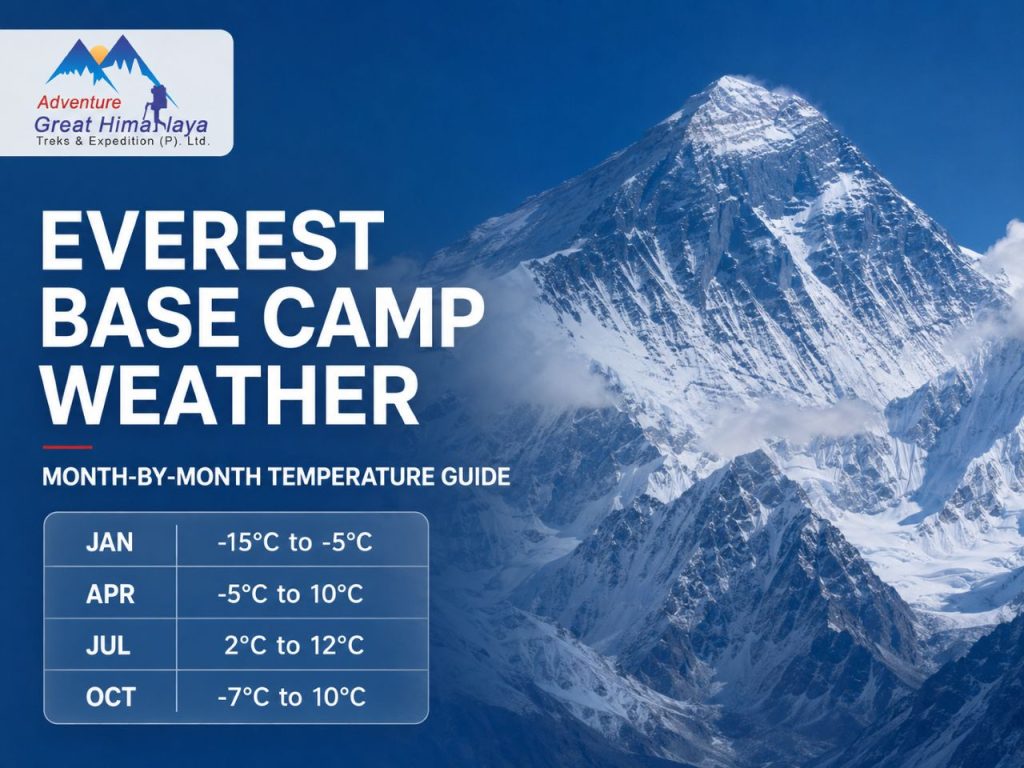
| January | -15°C to -5°C (5°F to 23°F) | -25°C to -15°C (-13°F to 5°F) | Less than 20 mm | Excellent on clear days | Very Low | Snowy, icy |
| February | -15°C to -5°C (5°F to 23°F) | -22°C to -15°C (-8°F to 5°F) | Less than 30 mm | Excellent on clear days | Very Low | Cold and icy |
| March | -10°C to 5°C (14°F to 41°F) | -18°C to -10°C (0°F to 14°F) | Around 30-40 mm | Good to Excellent | Moderate | Improving |
| April | -5°C to 10°C (23°F to 50°F) | -15°C to -5°C (5°F to 23°F) | Around 50-60 mm | Excellent | High | Mostly dry |
| May | -3°C to 10°C (27°F to 50°F) | -10°C to -3°C (14°F to 27°F) | Around 60-70 mm | Good, clouds increase | High | Generally good |
| June | 0°C to 10°C (32°F to 50°F) | -5°C to 2°C (23°F to 36°F) | Around 140 mm | Moderate to Poor | Low | Wet in lower areas |
| July | 2°C to 12°C (36°F to 54°F) | -3°C to 3°C (27°F to 37°F) | Highest rainfall of the year, over 200 mm | Poor | Very Low | Wet, muddy, slippery |
| August | 2°C to 12°C (36°F to 54°F) | -3°C to 3°C (27°F to 37°F) | Around 180-200 mm | Poor | Very Low | Wet and slippery |
| September | -2°C to 8°C (28°F to 46°F) | -8°C to -2°C (18°F to 28°F) | Around 100-120 mm | Improving | Moderate | Improving |
| October | -7°C to 10°C (19°F to 50°F) | -15°C to -5°C (5°F to 23°F) | Around 60 mm | Excellent | Very High | Dry and stable |
| November | -12°C to 5°C (10°F to 41°F) | -20°C to -10°C (-4°F to 14°F) | Around 20 mm | Excellent | Moderate–High | Dry, increasingly cold |
| December | -15°C to -5°C (5°F to 23°F) | -25°C to -15°C (-13°F to 5°F) | Less than 20 mm | Good–Excellent | Low | Cold, icy/snowy |
Everest Base Camp Weather in January
January is in full swing, making it one of the coldest months for the Everest Base Camp trek. At the base camp, daytime temperatures remain below freezing, and nighttime temperatures range from -25 °C to -15 °C (-13°F to 5°F). At Namche, the conditions are less severe than at the base camp; however, the mornings and nights can still be cold. In Dingboche, Lobuche, and Gorakshep, the trails are covered with snow and ice, making the journey difficult.
Although January is not the best month for trekking, it has some advantages. There are fewer crowds, which makes the trek isolated and silent. The constant blue sky offers good mountain views, and the only thing to watch out for is the cold.
Everest Base Camp Weather in February
In February, the winter cold slowly begins to fade. The daytime temperature is slightly warmer (-15°C to -5°C or 5°F to 23°F) than the nighttime temperature, which ranges from -22°C to -15°C (-8°F to 5°F). Daylight hours increase by 6 to 8 hours, which gives plenty of time for walking. Also, the trekking trail is quiet with minimal human traffic. You can also see the Himalayan views as the weather is mostly clear.
Everest Base Camp Weather in March
March marks the transition from winter to spring. Temperatures are more manageable, with daytime temperatures ranging from -10°C to 5°C (14°F to 41°F) and night temperatures from -18°C to -10°C (0°F to 14°F). March also marks the start of preparations for the Everest climbing season, bringing growing excitement to the region. Daylight hours grow longer each day, typically between 7 and 9 hours per day.
You can see blooming rhododendrons, and green forests come to life. Floras decorate the trekking trail, and views are mostly clear. Nighttime can be chilly, and trekkers must be prepared for sudden changes in the weather. During the Everest Base Camp trek in March, warm clothes and proper hydration are essential for comfort and safety.
Everest Base Camp Weather in April
April is the best month to travel in spring, as the season reaches its peak. The weather is pleasant, with flowers in bloom. The night temperature reaches around -15°C to -5°C (5°F to 23°F), which should be manageable. During the day, temperatures reach -5°C to 10°C (23°F to 50°F), which is comfortable for walking. Daylight lasts about 8-10 hours.
As the lower sections like Lukla, Phakding, and Namche bloom with rhododendrons, the higher mountains are clearly visible. Also, as it is the best spring month, expect larger crowds and busier trails. The accommodation options can also fill up quickly, so prior booking is necessary.
Everest Base Camp Weather in May
May is generally warmer than April, with daytime temperatures from -3°C to 10°C (27°F to 50°F) and nighttime temperatures ranging from -10°C to -3 °C (14°F to 27°F). Trekkers can feel relatively comfortable during the night’s stay, especially at high elevation. Also, mornings are beautiful and clear. However, toward the end of the month, some may experience pre-monsoon conditions, when moisture levels can increase. So it is recommended to carry an umbrella. May also coincides with the Everest climbing season, which allows trekkers to experience activities around Everest Base Camp and the Khumbu Icefall.
Everest Base Camp Weather in June
The monsoon season on Everest begins in June. The lower areas receive heavy rainfall, and occasional snow can fall at higher elevations. Daytime temperatures normally range from 0°C to 10°C (32°F to 50°F), and nighttime temperatures range from -5°C to 2°C (23°F to 36°F). The rain is usually misty, which can obstruct views of the mountain. The trails can also be muddy and slippery, especially in the forest section, so careful navigation is important.
Early June days are cool with very few people on the trail. So expect a cool, quiet, comfortable atmosphere. But due to heavy rainfall, there is a chance that Lukla flights will be postponed, so buffer days are essential.
Everest Base Camp Weather in July
The month of July brings heavy rainfall in the Everest Base Camp Trek. The day temperatures range from 2°C to 12°C (36°F to 54°F), whereas the night temperature ranges from -3°C to 3°C (27°F to 37°F). In the lower region, rain, clouds, mist, and poor visibility affect trekking conditions. Higher sections may occasionally receive snowfall rather than rain when temperatures fall sufficiently. The trekking trail becomes wet, which can tire the body when walking quickly. Mountain views are limited, and the risk of leech infestation is higher when walking in the forested area. So, July is not recommended for those who especially want to do the Everest Base Camp trek for clear views of Everest.
Everest Base Camp Weather in August
The beginning days of August are similar to July. The monsoon weather highly affects the journey. The weather in the mountains remains unpredictable, and trails are slippery. The average daily temperature ranges from 2°C to 12°C (36°F to 54°F), and the night temperature can go below freezing. So trekkers should expect intermittent rainfall during the month. Be sure to pack everything you need, including your waterproof gear and clothing.
By the end of August, rainfall slowly drops, and the heavy downpour will turn into a slight drizzle. Skies can still be cloudy, which can obstruct the views of Everest, Lhotse, Ama Dablam, and other peaks. However, the area will be quiet with only a few trekkers. Navigation is easy, and accommodation options can be cheaper due to less demand.
Everest Base Camp Weather in September
September marks the beginning of Autumn. The weather is pleasant, and the trails are starting to dry out after the monsoon rain. The air is fresh, and the temperature remains moderate. The average daily temperature ranges from -2°C to 8°C (28°F to 46°F). At night, the average temperature drops between -8°C and -2°C (18°F to 28°F). September skies mostly offer crystal-clear visibility, leading to unobstructed views of the magnificent snow-capped peaks.
The trekking trails leading to the Everest Base Camp are drier than the muddy trails during the monsoon. This makes trekking more comfortable and enjoyable. The weather and environmental factors are pretty much predictable and safer. Also, since September is just the start of Autumn, the trekking trails remain relatively peaceful and less crowded than during the peak months.
Everest Base Camp Weather in October
October is undeniably the most favorable trekking month for the Everest Base Camp Trek. The weather is absolutely stable, with very little to no rainfall, crystal-clear skies, and spectacular views of the surrounding mountains and landscapes. Daytime temperatures range from -7°C to 10°C (19°F to 50°F) on average. During nights, the temperature can range from -15°C to -5°C (5°F to 23°F).
The trekking trail is significantly more crowded in October, as it is generally considered the best and peak month in the trekking calendar. The accommodation options, including tea houses, guesthouses, and comfort lodges, are generally pre-booked, and last-minute bookings might not be entertained. Hence, preparing the accommodation logistics would be ideal. Still, October is the best and most favorable month to trek to the Everest Base Camp.
Everest Base Camp Weather in November
The Everest region starts to feel cold with the arrival of winter in November. The daytime temperature ranges from -12°C to 5°C (10°F to 41°F), and the night temperature ranges from -20°C to -10°C (-4°F to 14°F). Although colder, November still offers stable weather and suitable conditions for a trek to EBC.
Many trekkers still prefer to trek to Everest Base Camp in November. But the number of trekkers is still relatively low compared to the peak trekking month of October. Therefore, the trails are comparatively peaceful and less congested. Logistics are also less hectic than in October. November would be the best month for the Everest Base Camp Trek for those who do not mind a bit of winter cold. It offers the best balance of climate, environmental conditions, and trail traffic.
Everest Base Camp Weather in December
December brings extreme cold temperatures in the Everest region. The average daytime temperature ranges from -15°C to -5°C (5°F to 23°F). At night, temperatures can drop between -25°C and -15°C (-13°F to 5°F). Mornings and evenings are still quite chilly, but trekkers will be comforted by the perfect mild sunlight during the day. The surrounding scenery, mountain peaks, and landscapes are still mesmerizing in their whiteness.
December offers peaceful trekking trails perfect for trekkers seeking solitude along the river. However, proper preparation for gear, equipment, clothing, and layering is required, as the freezing temperatures can be unbearable for some. Also, higher sections of the trek or high passes might not be crossable due to snowy or icy conditions in rare cases. Overall, December offers an extraordinary trekking experience for trekkers who seek a peaceful trek and can bear a bit of coldness.
Best Months to Visit Everest Base Camp for Weather
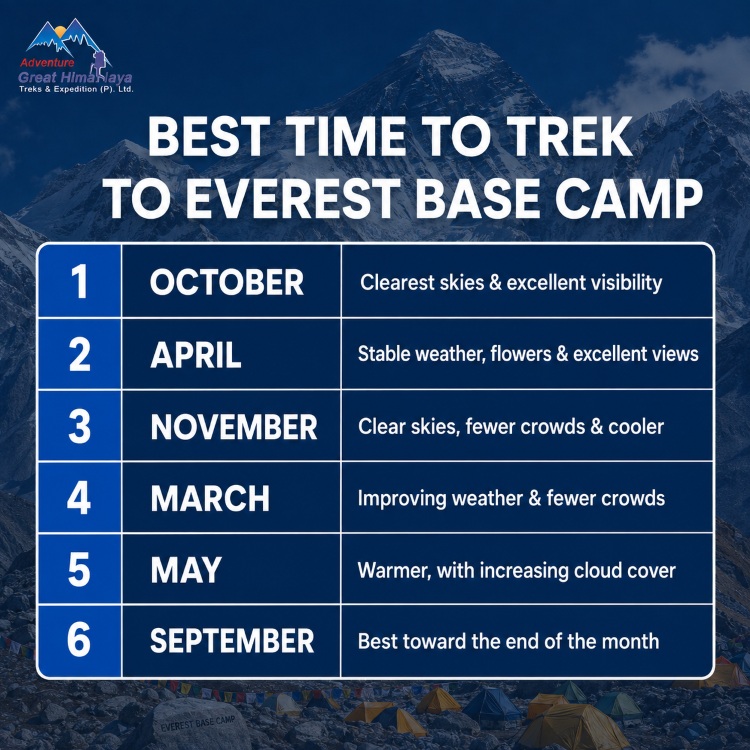
The best months to visit EBC for most travelers are March to May and September to November. If weather and mountain visibility are your highest priorities, then October generally ranks first. But if you want a combined experience with scenery and mountain views, then April can be the best choice. Here are some recommended rankings, comparisons between the spring and autumn seasons, and a comparison of the best season depending on the traveler’s type for the Everest trek.
Recommended Ranking
| Rank | Month | Why |
| 1 | October | Clearest skies, dry trails, excellent visibility |
| 2 | April | Stable weather, spring flowers, excellent views |
| 3 | November | Clear skies, fewer crowds, cooler temperatures |
| 4 | March | Improving weather, fewer crowds, spring beginning |
| 5 | May | Warmer conditions, but increasing cloud cover |
| 6 | September | Improving after monsoon, especially late month |
Spring vs. Autumn for Everest Base Camp
| Feature | Spring | Autumn |
| Months | March to May | September to November |
| Weather | Stable and warming | Stable and cooling |
| Mountain visibility | Excellent | Usually exceptional |
| Flowers | Rhododendrons bloom | Autumn landscapes |
| Temperatures | Gradually warmer | Gradually colder |
| Crowds | High in April–May | Very high in October |
| Everest climbing activity | High | Lower |
| Best month | April | October |
Choose spring if you want to:
- See Rhododendron flowers
- Trek in warmer conditions
- Have long daylight
- See spring mountain landscape
- Click excellent photographs.
Choose Autumn if you want to:
- See the clearest mountain views
- Walk on dry trails
- Trek on stable weather condition
- See crisp blue skies
- Experience the classic Everest Base Camp trek
Best Season by Traveler Type
| Traveler Type | Recommended Month | Reason |
| First-time trekker | October or April | Stable conditions and good trail availability |
| Photographer | October | Exceptional visibility |
| Flower lover | April–May | Rhododendron blooms |
| Budget traveler | March or November | Shoulder-season possibilities |
| Solitude seeker | December–February | Very low crowds |
| Experienced winter trekker | January–February | Snowy landscapes and solitude |
| Experienced monsoon trekker | June–August | Quiet trail and unique conditions |
Everest Base Camp Region Temperatures: From Lukla to Base Camp
| Location | Approx. Elevation | General Temperature Pattern |
| Lukla | 2,860 m / 9,383 ft | Mildest; relatively comfortable during the day |
| Namche Bazaar | 3,440 m / 11,286 ft | Cool days, cold mornings and nights |
| Tengboche | 3,860 m / 12,664 ft | Noticeably colder, especially after sunset |
| Dingboche | 4,410 m / 14,469 ft | Cold and dry; freezing nights |
| Lobuche | 4,910 m / 16,109 ft | Very cold, particularly at night |
| Gorak Shep | 5,164 m / 16,942 ft | Freezing to severely cold |
| Everest Base Camp | 5,364 m / 17,598 ft | Extremely cold at night; wind can intensify exposure |
| Kala Patthar | 5,545 m / 18,192 ft | Colder and more exposed than Base Camp |
Final Thoughts – The Best Everest Base Camp Trekking Seasons
There is no single month, weather-wise, when the Everest Base Camp trek is perfect. While some provide greenery, others provide cool temperatures. The best time to visit is always when you are prepared enough to take on the challenge. Also, if your priority is clear mountain views and reliable trekking conditions, then the best month to travel is October. However, trekkers should be able to cope with the crowd level that October brings. Also, if you want a more scenic trek experience while taking in greenery and blooming rhododendrons, Spring is the best option.
November and March also work well for trekkers who wish for relatively good weather. However, it is strongly advisable not to trek from December to February, as the weather is worse. Most teahouse owners in Gorakhshep and Lobuche also close down due to extreme cold. June to August is the most challenging period for the Lukla flight. As visibility is very poor, flying in such conditions is potentially dangerous. Thus, the most important thing is to prepare for the conditions rather than averages. Mountain weather can change, so pack accordingly and protect yourself at all times.
Book with Adventure Great Himalaya Pvt. Ltd. for your Everest Base Camp Trek. Do explore our EBC packages and itineraries. Choose the dates that best suit your conditions. Contact us for a customized itinerary matching your personal interests.
Frequently Asked Questions
What is the Best Month to Trek to Everest Base Camp?
The best trekking seasons for Everest Base Camp are Spring (March to May) and Autumn (September to November). In Spring, April is generally considered the best trekking month due to moderate temperatures, excellent trail conditions, blooming rhododendron forests, and monsoon rains still far away. Similarly, Autumn’s best month is October, with perfect weather, crystal-clear skies, unobstructed mountain views, and major festivals such as Dashain and Tihar.
How Cold Does it Get at Everest Base Camp?
Temperatures at Everest Base Camp (5,364 m/17,598 ft) vary by season. However, it generally remains cold throughout the year. During the peak trekking seasons of Spring (March to May) and Autumn (September to November), average daytime temperatures can range from -5 to 10℃ (23 to 50℉). At night, temperatures can range from -15 to -5℃ (5 to 23℉). Similarly, during winter months (December to February), average daytime temperatures range from -15 to 0℃ (5 to 32℉). At night, temperatures can drop between -25 and -10℃ (-13 and 14℉) or lower.
How Does the Weather Impact Acclimatization?
Yes, weather can affect acclimatization during the Everest Base Camp Trek, even though altitude is the main factor determining the acclimatization process. Colder temperatures, along with altitude gain, can add to the physical challenge of trekking. Harsh weather conditions can also make it difficult to maintain a steady pace or even follow the pre-designed itinerary, which can impact acclimatization. Cold conditions can also make rest and recovery more difficult at higher altitudes.
Are There Any Months to Avoid Trekking to Everest Base Camp?
Although the Everest Base Camp Trek can be done throughout the year, some months are considered relatively less favorable. June, July, and August bring monsoon rains, and the lower sections of the trek can receive frequent rainfall. This can result in muddy, challenging trails, reduced visibility, and impact flights to and from Lukla. Similarly, December, January, and February experience harsh, extreme cold, challenging trekkers in every way.
What Should I Wear for the Everest Base Camp Trek in Winter?
For the Everest Base Camp Trek in winter, proper layering is essential to protect yourself from extreme cold. For the upper body, a thermal base layer, a warm mid-layer, and an insulated down jacket should be enough. Similarly, for the lower body, thermal leggings as a base layer, along with warm trekking trousers, should be good. Warm pairs of wool socks or thermal socks are also essential. Other miscellaneous accessories include a warm pair of gloves, a warm hat, a neck buff, sunglasses, etc.
How Do I Stay Safe While Trekking During Monsoon Season?
Trekking during the Monsoon season requires thorough preparation due to heavy rainfall, muddy, slippery trails, obstructions, leeches, and flight disruptions. Trekkers should always navigate the weather and the trail conditions. They should be ready to keep their itinerary flexible in case of any last-minute changes due to unforeseen circumstances. Using proper gear, including trekking boots, to conquer slippery trails; avoiding water crossings at extremely high water levels; avoiding unstable sections on the trail; and always following the guidance of guides are essential to stay safe while trekking during the monsoon.
Should I choose April or October?
Both April and October are considered the best months for trekking, with Spring and Autumn, respectively. However, October still has the upper hand, as it offers the best conditions for trekking to Everest Base Camp. October falls immediately after the rainy monsoons, so the atmosphere remains fresh, skies are clear, weather is stable, trail conditions are perfect, and trekkers can enjoy spectacular, unobstructed views of the surrounding snow-capped peaks and landscapes.
What is the coldest month at EBC?
January is the coldest month at EBC, with temperatures easily dropping below freezing. Daytime temperatures can range from -15 to -5℃ (5 to 23℉) on average. At night, temperatures can range from -25 to -15℃ (-13 to 5℉) or even lower.
What is the hottest month at EBC?
July and August are generally considered the hottest months at Everest Base Camp. The peak daytime temperature can range from 2 to 12℃ (36 to 54℉). But these months also coincide with monsoon season, which can bring frequent rainfall or cloud cover throughout the trekking period.
Which is colder, Kala Patthar or Everest Base Camp?
Kala Patthar is generally colder than Everest Base Camp. Kala Patthar (5,545 m/18,192 ft) stands about 181 meters higher than Everest Base Camp (5,364 m/17,598 ft). Higher elevation means the harsh winds and temperature variations make Kala Patthar colder than EBC. However, the difference can be very minute.
Speak to our local travel expert, who can assist you in planning your trip.
PLAN YOUR TRIP Friday, September 18th, 2026
Top 10 Best Trekking Operators in Kathmandu, Nepal
 Friday, September 18th, 2026
17+ Best Things to Do in Kathmandu, Nepal
 Sunday, September 6th, 2026
Annapurna Base Camp Trek from Pokhara
 Wednesday, September 2nd, 2026
Best Everest Three Pass Trek Company in Nepal
 Tuesday, September 1st, 2026
26 August 2026 Nepal-Tibet Border Flash Flood
 Tuesday, September 1st, 2026
How to Get to Everest Base Camp from Kathmandu?
 Monday, August 31st, 2026
Everest Base Camp Trek Permit, TIMS & Guide Requirements
 Thursday, May 7th, 2026
Manaslu Trek Routes Guide
 Thursday, June 11th, 2026
Is Nepal Safe for Tourists? Travel Safety Guide
 Thursday, June 11th, 2026
Spiritual Travel in Nepal: A Guide for Seekers
 Monday, April 27th, 2026
Manaslu Trek Booking with Tour Guide Vs Agency
 Sunday, April 19th, 2026
10 Reasons You Should Hike Annapurna Circuit
 Thursday, April 16th, 2026
How to Choose Best Annapurna base Camp Trek Agency
 Tuesday, July 7th, 2026