


Everest Base Camp Trek Permit, TIMS & Guide Requirements
The Everest Base Camp trek requires specific entry permits and trekking documents that comply with current government regulations. The standard EBC route passes through the Sagarmatha National Park and through Khumbu Pasang Lhamu Rural Municipality. So both of these permits are essential. If these licenses are not obtained, further entry is restricted. Also, trekkers should be up to date with the latest official regulations for a hassle-free and safe trekking experience.
Every trekker on this route needs to account for national park entry, a local municipality fee, and depending on current enforcement: TIMS registration, alongside a mandatory licensed guide. Because these rules have changed more than once in recent years, relying on outdated information can mean arriving at a checkpoint without the right paperwork.
This blog walks you through everything you need before you go: which permits are required, what they cost, where to get them, whether TIMS still applies to EBC specifically, guide requirements, and what a trekking agency like Adventure Great Himalaya handles on your behalf.
Last Verified on August 2026. Always confirm current requirements with the Nepal Tourism Board before travelling. Permit rules, fees, and guide regulations in Nepal can change with little notice.
What Permits Do You Need for the Everest Base Camp Trek?
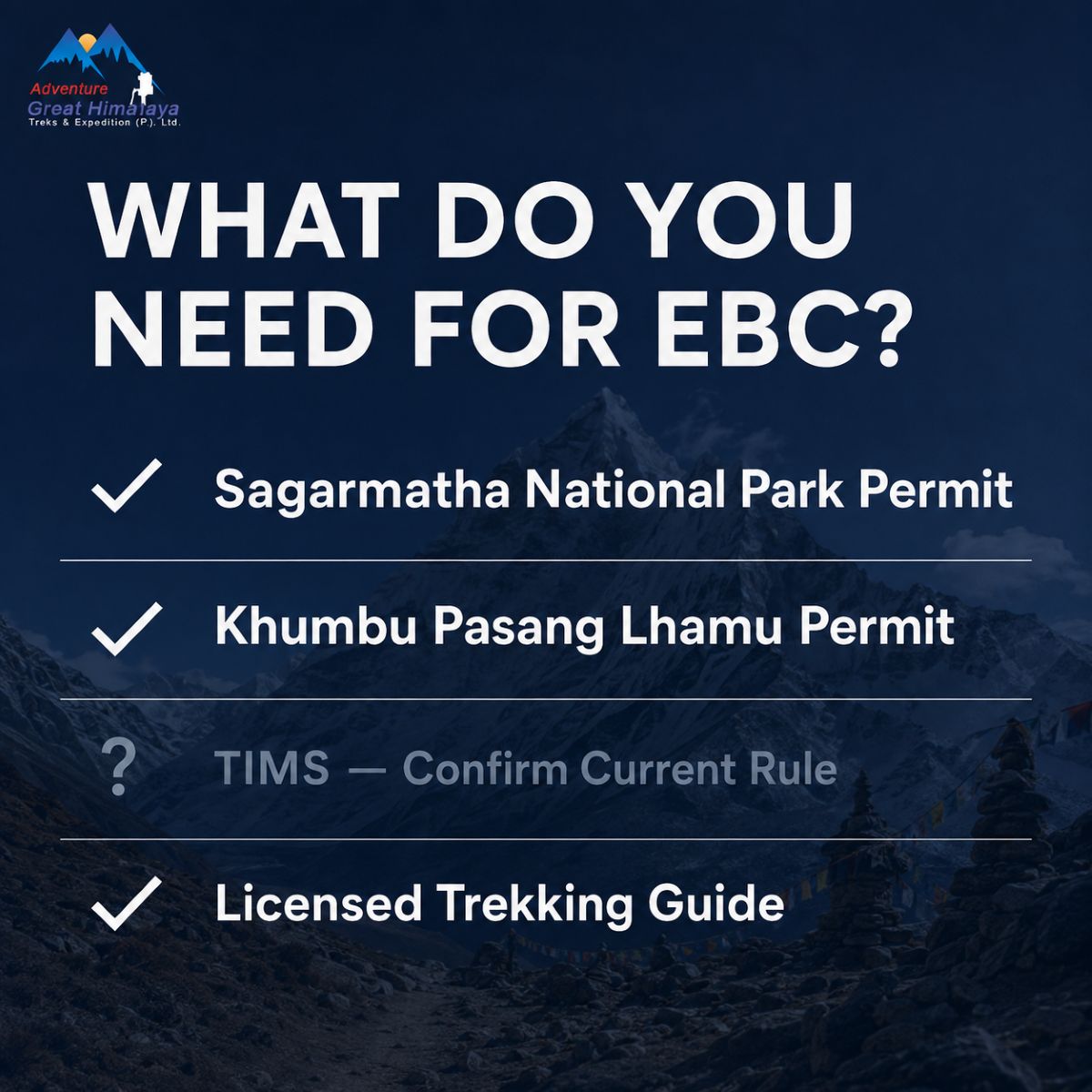
All trekkers on the regular Everest Base Camp trek must have two essential permits: the Sagarmatha National Park Entry Permit and the Khumbu Pasang Lhamu Rural Municipality Permit. It is also required to have a licensed trekking guide. The enforcement of TIMS on this particular route is inconsistent across sources and is covered in detail in the dedicated TIMS section below.
| Permit / Document | Required? | Purpose | Where Obtained |
| Sagarmatha National Park Entry Permit | Yes | Entry into Sagarmatha National Park | Kathmandu (NTB office) or Monjo entry gate |
| Khumbu Pasang Lhamu Rural Municipality Permit | Yes | Local trekking/entry fee for the Khumbu region | Lukla or Monjo |
| TIMS Card | Position varies by source : see TIMS section | Trekker registration and safety tracking | Through a registered trekking agency where applicable |
| Licensed Trekking Guide | Yes (mandatory since April 2023) | Required for all foreign trekkers in Nepal | Registered trekking agency |
| Gaurishankar Conservation Area Permit | Only for the Jiri approach | Entry for the Jiri–Namche route | Relevant conservation office |
| Restricted Area Permit | No, for the standard EBC route | Only applies to restricted areas elsewhere in Nepal | Department of Immigration |
Sagarmatha National Park Entry Permit
The Everest Base Camp trek route lies within Sagarmatha National Park, a UNESCO World Heritage Site established to safeguard the ecology and Sherpa communities of the Khumbu region.
The cost of the permit is approximately NPR 3,000 (around USD 22-23), plus 13% VAT for foreign nationals, bringing the total to approximately NPR 3,390 (around USD 22-23). SAARC nationals usually pay a lower rate. The permit is checked only once at the park entrance gate in Monjo and is valid for the entire trek.
It can be purchased in advance at the Nepal Tourism Board office in Kathmandu or at the Monjo entry gate. Most trekkers buy their EBC trek permit from their trekking agency in advance to avoid delays at the EBC permit point.
Khumbu Pasang Lhamu Rural Municipality Permit
The Khumbu local permit was first introduced in 2023. It is an addition to the national park fee. It will support local municipal services in the Khumbu Pasang Lhamu Rural Municipality, the local government unit responsible for the Everest region.
This is a municipal entry fee, as opposed to the national park permit, which is used for conservation purposes. The price at the moment is about NPR 2000-3000 per person, usually cash only, and is rarely accepted at the checkpoint.
It is issued in Lukla or checked at Monjo, in addition to the national park permit. It is not necessary to make arrangements for this before departing from Kathmandu, as the guides will handle it on site; it is advisable to check with the municipality or a registered agency before making independent arrangements.
Do You Need a Special Everest Climbing Permit for EBC?
No. An Everest Base Camp trek is quite different from an Everest summit trek. As a trekker, you don’t need a climbing permit to reach Base Camp on foot, nor do you need to be a member of the mountaineering royalty or a Department of Tourism permit to travel to Base Camp. The only permits and TIMS documentation required for Base Camp trekkers are those outlined in this guide.
Everest Base Camp Trek Permit Cost and Validity
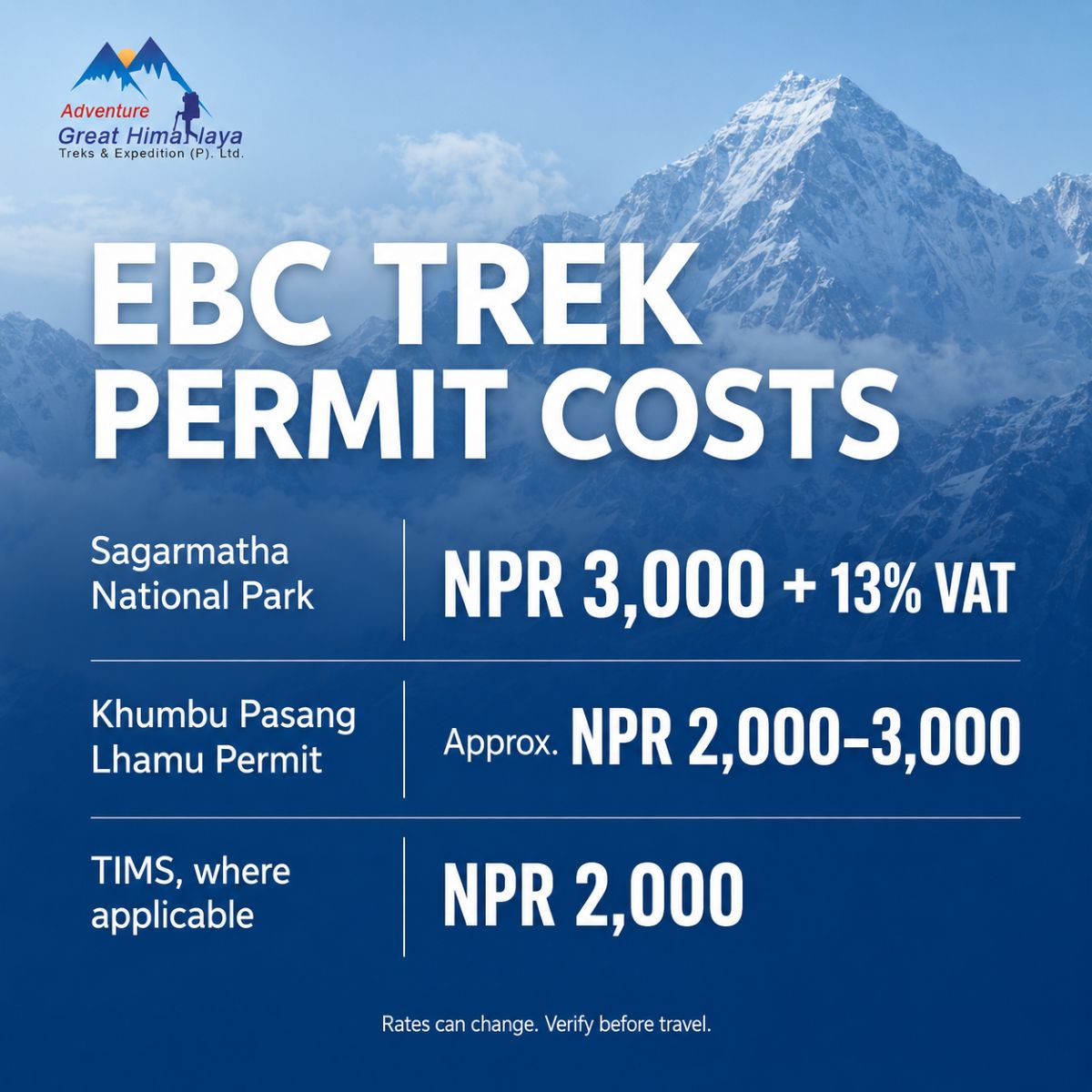
Permit fees are typically quoted in Nepali Rupees (NPR) and are usually paid in cash at checkpoints or arranged in advance by a trekking agency. The fees below are indicative for the 2026 season.
| Permit | Foreign Nationals | SAARC Nationals | Nepali Citizens | Validity |
| Sagarmatha National Park | ~NPR 3,000 + 13% VAT (~NPR 3,390) | Reduced rate: confirm current figure | Nominal / discounted fee | Single entry, valid for the trek duration |
| Khumbu Pasang Lhamu Municipality | ~NPR 2,000–3,000 (sources vary) | Reduced rate: confirm current figure | Nominal / discounted fee | Single entry, valid for the trek duration |
| TIMS | NPR 2,000 (per official NTB rate) where applicable | NPR 1,000 (per official NTB rate) where applicable | Not typically required | Valid for the registered trek dates |
Are Everest Base Camp Permit Fees Included in Trek Packages?
Yes, the fees are included. Adventure Great Himalaya includes the permit cost in all its EBC trekking packages. Most reputable trekking packages bundle the following, so you don’t need to arrange each item separately:
- National park permit
- Local Khumbu permit
- TIMS documentation, where applicable
- Licensed guide
- Porter, if included in your package
- Teahouse accommodation
- Meals as specified in the itinerary
- Domestic transport that includes Lukla flights
Always confirm with the agency about which permits and services are included before booking. Packages can vary between operators, and Adventure Great Himalaya can confirm the current inclusions for any EBC itinerary.
Where Are Everest Base Camp Trek Permits Issued?
Can You Get the Everest Base Camp Permit in Kathmandu?
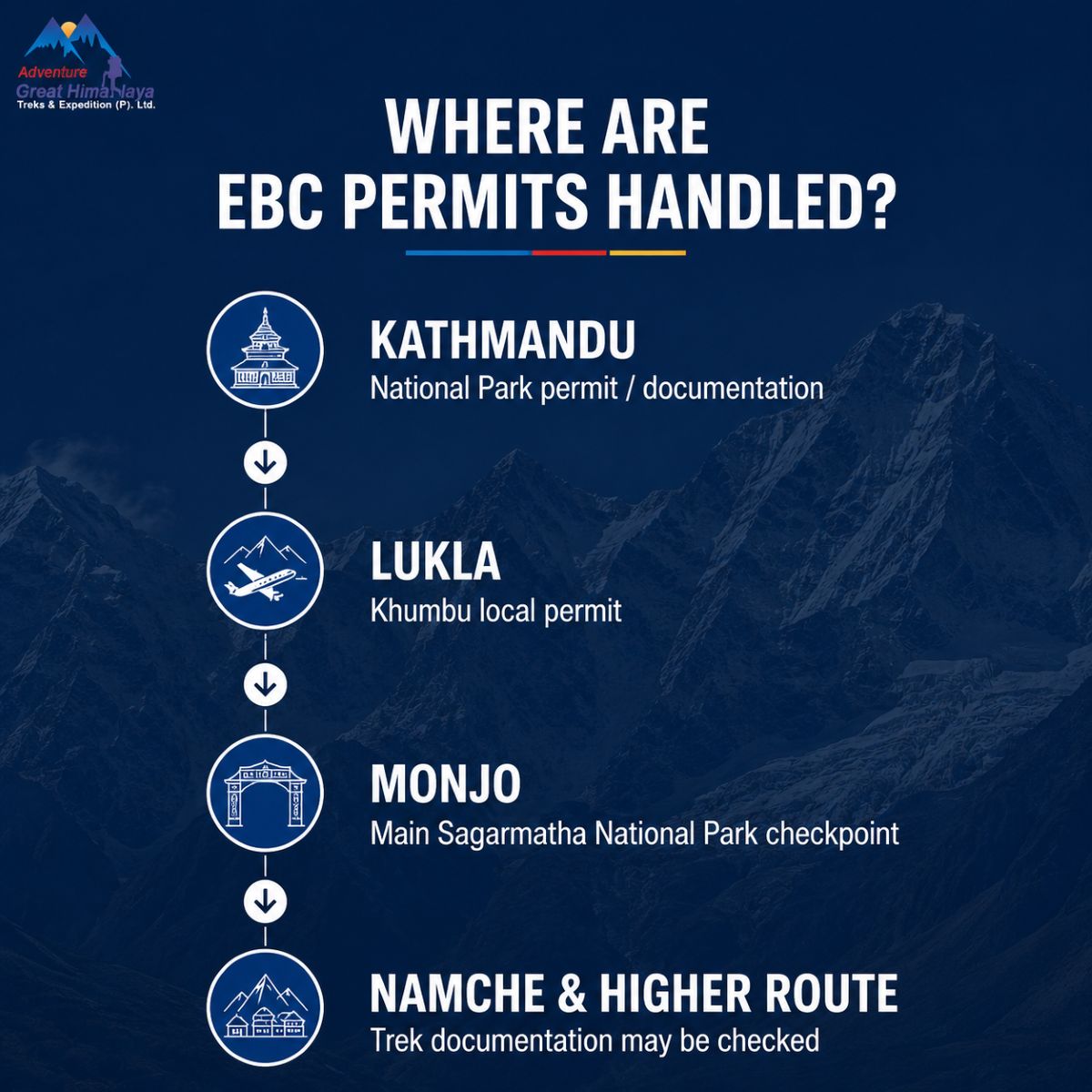
Yes. The Sagarmatha National Park Entry Permit can be obtained in Kathmandu at the Nepal Tourism Board office, and a registered trekking agency can handle TIMS documentation (if necessary) before departure. Getting in order what you can in Kathmandu will minimize the delays once on the trail.
Can You Get the Permit in Lukla?
After landing, you can get or verify the Khumbu Pasang Lhamu Rural Municipality Permit in Lukla. Always pay cash, as card payments are not accepted for this local fee.
Can You Get the Permit at Monjo?
Monjo is the primary checkpoint for Sagarmatha National Park and the most crucial permit checkpoint along the entire route. Here, the national park permit and, depending on the current enforcement, the local municipality permit are checked before you head on to Namche Bazaar. At this point, trekkers without a valid permit or a valid guide credential are turned back
Do You Need to Arrange the Permits Before Flying to Lukla?
It is strongly recommended, but not required, for all permits. If you book the national park permit and any required TIMS documents in Kathmandu before your Lukla flight, you will avoid the hassle and potential delays at the checkpoints.
Note: Book through a registered trekking agency, such as Adventure Great Himalaya, that arranges all necessary permits before you begin the trek, so you don’t have to navigate multiple offices yourself.
What Documents Do You Need for an Everest Base Camp Trek Permit?
Document requirements for the Everest Base Camp trek are straightforward, but gathering them in advance saves time in Kathmandu before your Lukla flight. Here’s what you’ll need:
- Valid passport (original, not just a copy)
- Photocopy of your passport details page
- Passport-size photographs, if required by the issuing office
- Visa documentation, where applicable
- Trekking itinerary
- Emergency contact information
- Travel insurance details
- Agency and guide details, where applicable
Do You Need Travel Insurance for the EBC Trek?
Even though Travel insurance is not required for a trekking permit, it is strongly recommended for anyone trekking to Everest Base Camp. Practical risks are real at such altitudes, and insurance that specifically covers high-altitude trekking is important for:
- Medical treatment
- Flight delays and cancellations
- Trip interruption and cancellation
- Emergency evacuation
- Loss of Personal items
Confirm that your policy covers trekking at an altitude above 4000 m, as many standard travel policies exclude high-altitude activities above a certain elevation.
Not having insurance coverage in a situation like this means paying the full cost on your own if anything happens. For example, a high-altitude helicopter evacuation from Khumbu can be quite expensive, thousands of US dollars, and if there is no insurance coverage, then all the costs are paid by you personally. Altitude sickness treatment, a failed Lukla flight, or an early termination of the trek can become very costly experiences for you.
Is TIMS Required for Everest Base Camp?
In practice, TIMS has now been replaced in the Khumbu region by the Khumbu Pasang Lhamu Rural Municipality Permit, which is used alongside the Sagarmatha National Park Entry Permit.
Trekkers following the regular Lukla to Everest Base Camp route therefore need the Sagarmatha National Park Entry Permit and Khumbu Pasang Lhamu Rural Municipality Permit, rather than purchasing a separate TIMS card. The local Khumbu permit is issued to visitors entering Khumbu Pasang Lhamu Rural Municipality. It is handled at the local level, not through the traditional TIMS system.
What Is a TIMS Card?
TIMS stands for the Trekkers’ Information Management System. It was introduced in 2008 by Nepal Tourism Board and the Trekking Agencies’ Association of Nepal (TAAN) to keep track of trekker information and itineraries for safety and search and rescue.
TIMS continues to be used on trekking routes elsewhere in Nepal, but the Everest/Khumbu region follows its own local permit and trek-registration system. It is issued by the Nepal Tourism Board or a registered trekking agency and a photocopy of your passport details and passport size photographs are required to get it.
Why Does the Nepal Tourism Board Website Still List TIMS for Everest Base Camp?
The Nepal Tourism Board’s current TIMS page still lists it as a mandatory document for Everest Base Camp trek along with a TIMS fee of NPR 1,000 for SAARC nationals and NPR 2,000 for other foreign trekkers. But our trekkers have found that currently, Khumbu Pasang Lhamu Rural Municipality has started issuing its own permit, and trekkers on the EBC route use this local permit together with the Sagarmatha National Park permit instead of a TIMS card. Because of this, we do not treat TIMS as an additional permit required for an Everest Base Camp trek.
Is a Licensed Guide Mandatory for the Everest Base Camp Trek?
Yes, Nepal has implemented a new rule for all foreign trekkers to hire a trekking guide from a registered trekking agency on major trekking routes, including Everest Base Camp, since April 1, 2023. The government does not allow solo and unguided foreign trekking on this route at present.
Do You Need a Guide for EBC?
Yes, foreign trekkers on the Everest Base Camp route must have a registered trekking agency’s licensed guide. This requirement has been in place since April 2023 and is enforced at the Sagarmatha National Park entry point at Monjo where trekkers without a valid guide’s credential are refused entry.
Can You Trek EBC Alone?
Being physically able to walk the trail independently and legally is two different things. As per the policy of the Nepal government, foreign trekkers are not legally allowed to trek up to EBC without a licensed guide irrespective of their trekking experience or fitness level.
Older articles on fully independent EBC trekking are not relevant to the 2023 guide mandate. Whether enforcement details are different in each season, it is best to hire a licensed guide for safety, altitude management, and logistics purposes, even if it is not legally required.
Can You Hire a Guide in Lukla?
A local guide can be hired in Lukla but it is easier and safer to arrange one in advance through a registered trekking agency. An agency-arranged guide is licensed, held accountable, and has pre-arranged logistics, while checking the credentials of a guide on the spot in Lukla adds uncertainty at the beginning of your trek..
What Does an Everest Base Camp Trek Guide Do?
Beyond meeting the legal requirement, a licensed guide plays an active role in keeping the trek safe and running smoothly. Their responsibilities go well past simply walking the route with you.
- Route navigation across the trail’s changing terrain and weather
- Altitude monitoring and acclimatization pacing
- Weather-based itinerary decisions
- Teahouse coordination and booking
- Emergency assistance and evacuation coordination
- Communication support, including with local communities
- Permit and checkpoint support
- Local cultural knowledge and context
Can You Trek to Everest Base Camp Independently?
Fully independent trekking without a licensed guide is not permitted under current regulations, for foreign nationals on the Everest Base Camp route. The comparison below illustrates the practical differences trekkers weigh when considering how much they arrange themselves versus through an agency.
Independent Trekking vs. Guided Trekking
| Feature | Independent | Guided |
| Guide | Not legally permitted for foreign trekkers | Licensed guide included |
| Permit handling | Trekker’s responsibility | Handled by the agency |
| Navigation | Self-managed | Handled by guide |
| Altitude monitoring | Self-managed | Actively monitored by guide |
| Accommodation | Self-arranged | Usually pre-arranged |
| Emergency support | Limited | Professional support |
| Local knowledge | Limited | High |
| Regulatory compliance | Trekker’s responsibility | Agency assists |
Why Independent EBC Trekking Can Be More Complicated Than It Looks
- High altitude and the real risk of altitude sickness
- Rapid, unpredictable weather changes in the Khumbu
- Frequent Lukla flight delays and cancellations
- Route changes due to conditions or closures
- Variable teahouse accommodation availability, especially in peak season
- Limited options for emergency evacuation without local coordination
Everest Base Camp Trek Requirements for Children and SAARC Nationals
Can Children Trek to Everest Base Camp?
There is no one-size-fits-all minimum-age guideline for all children. The ability to make the trip safely will depend on physical fitness, previous high elevation experience and the conservative pace set for acclimatization. That judgment is the responsibility of parents and/or guardians, ideally with the help of a professional guide.
A well-planned, moderate pace with acclimatization days and a knowledgeable guide significantly minimizes risk, but no trip can ensure that every child successfully and safely makes it to Base Camp without discomfort.
Are Permit Fees Different for SAARC Nationals?
Yes, the permit and TIMS fee system in Nepal differs between foreign nationals, SAARC nationals (citizens of countries of the South Asian Association for Regional Cooperation) and Nepalis, with the SAARC nationals paying lower fees. Always check the latest numbers with official sources as third party sites don’t always have the same numbers, consult the fee table above.
Do Indian, Bangladeshi, Bhutanese, Sri Lankan and Other SAARC Trekkers Need the Same Documents?
The main document requirements (passport, photos, permit applications) are generally the same for all nationalities, although fees may vary and in some instances, documentation may be requested differently. The route specific permit requirements outlined in this guide (Sagarmatha National Park and Khumbu Pasang Lhamu permits, plus a licensed guide) are applicable to all nationalities.
Everest Base Camp Permit Checkpoints Along the Trek
The permits to trek to the Everest Base Camp are carefully checked at different checkpoints on the way, and not only at the beginning of the trek. Trekkers need to anticipate that their documents will be checked more than once when passing through the Khumbu area, and failing to present a valid permit or guide card is sufficient reason to return.
| Location / Checkpoint | What Is Checked | Why It Matters |
| Lukla | Local trekking documentation | Entry into the Khumbu region |
| Monjo | Sagarmatha National Park entry permit | Main national park checkpoint on the route |
| Namche Bazaar / Khumbu | Trek documentation | Verification as you continue up-valley |
| Higher-route checkpoints | Permit and trekker information | Ongoing compliance and safety tracking |
Keep your passport, permits, TIMS or other documentation, and your agency’s contact details easily accessible throughout the trek : you may be asked to present them at more than one point along the route.
Official Sagarmatha National Park material identifies Monjo as the lower-elevation entrance to the park area and describes the popular route continuing from Namche Bazaar up toward Kala Patthar.
What Does a Trekking Company Arrange for You?
Adventure Great Himalaya arranges the full set of permits, documentation, and logistics required for the Everest Base Camp trek, so trekkers don’t have to coordinate multiple offices or checkpoints themselves.
- Everest Base Camp trek permits
- TIMS documentation, where currently required
- A licensed Everest Base Camp trek guide
- Porter services
- Teahouse accommodation
- Meals along the route
- Domestic transportation, including Lukla flights
- Trekking itinerary planning
- Emergency coordination
- Documentation support
- Checkpoint compliance
Why Book Your EBC Trek Through a Registered Trekking Agency?
A registered agency makes it easy to comply with the rules because the guide requirement, permit application and processing, and TIMS documentation (if applicable) are taken care of by the agency and they know what is required from year to year. It also means quicker response if plans need to change: flight delays, weather or an itinerary adjustment for acclimatization are much easier to deal with when you have a local team taking care of your accommodation and logistics.
Adventure Great Himalaya provides all the necessary permits, licensed guides, documentation and accommodation for Everest Base Camp treks, along with Lukla flights and emergency support, allowing trekkers to concentrate on the trek itself and not the paperwork.
Common Mistakes Trekkers Make With EBC Permits
Even well-prepared trekkers run into the same avoidable issues year after year. Here are the mistakes worth watching for before you set out.
- Assuming TIMS Rules Never Change: Over the last few years, TIMS enforcement and requirements have changed several times by route. Two seasons ago, it may have been true, but not now.
- Confusing a National Park Permit With a Trekking Permit: The Sagarmatha National Park permit is not a substitute for the Khumbu Pasang Lhamu municipality permit and vice versa.
- Thinking a Visa Is the Same as a Trekking Permit: The entry visa to Nepal is not valid for Sagarmatha National Park or Khumbu trekking.
- Forgetting the Local Khumbu Permit: The national park fee is often included in the budget, but trekkers forget to budget for the Khumbu Pasang Lhamu Rural Municipality permit which is checked at a different point.
- Relying on Outdated Blog Posts: TIMS and guide rules have been updated frequently since 2023, so be sure to verify older articles with the latest official rules.
- Trekking Without Checking Current Guide Regulations: Arriving at Monjo without a verifiable licensed guide can result in being turned back at the checkpoint.
- Not Carrying Permit Copies: Permits and TIMS documentation are checked at multiple points along the route : keep them accessible, not buried at the bottom of a pack.
- Leaving No Time for Permit Processing: The day before your Lukla flight arrives in Kathmandu leaves you with little time to spare if you have to wait for a permit or TIMS to be processed.
Everest Base Camp Trek Permit and Guide Requirements: Quick Checklist
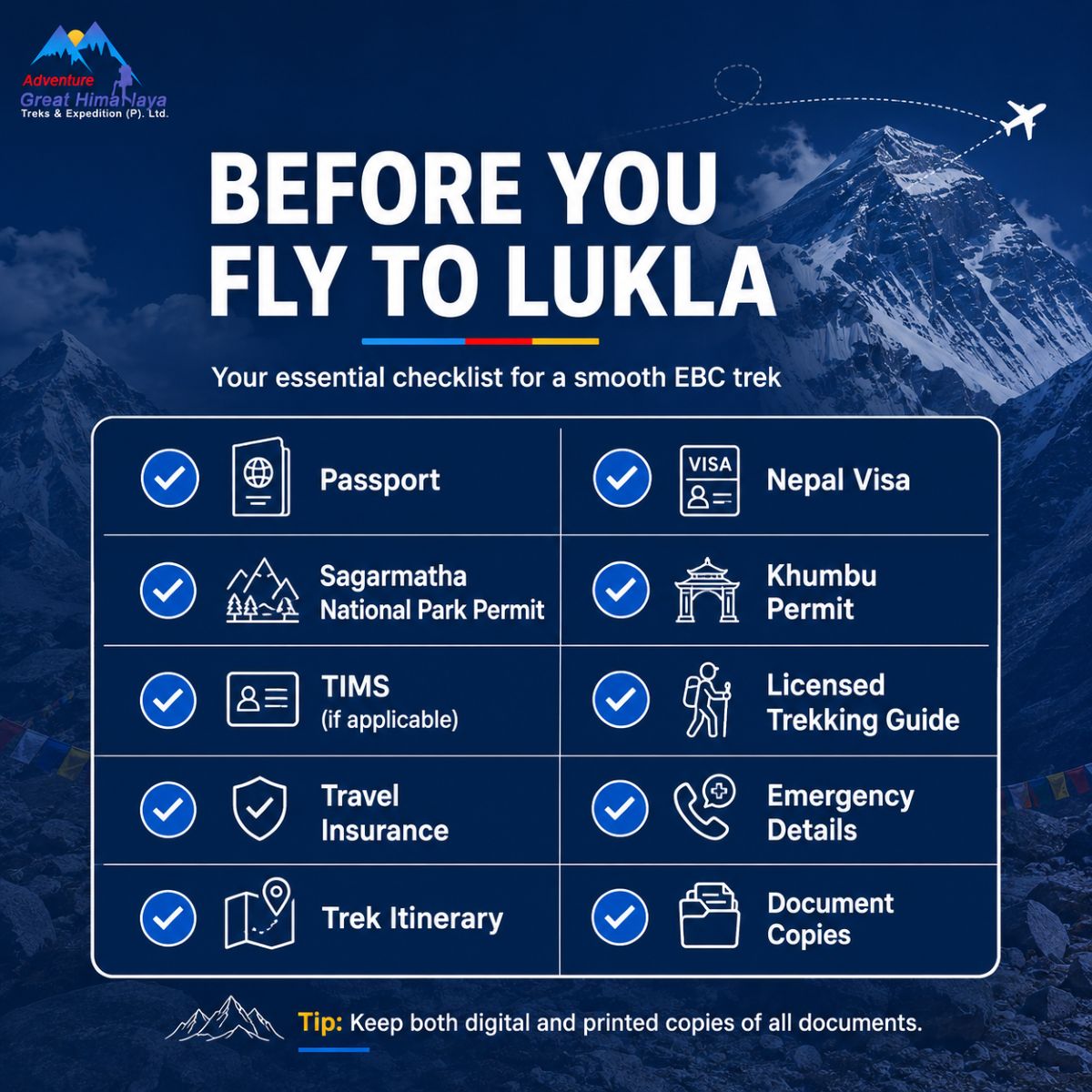
A trekker has to keep a lot of things in mind before travelling. For foreign nationals and new trekkers , this is more hectic as they might not be familiar with all the things needed before the trek. Use this checklist to confirm you have everything in order before you fly to Lukla.
☐ Valid passport
☐ Nepal visa
☐ Sagarmatha National Park permit
☐ Khumbu Pasang Lhamu permit
☐ Current TIMS documentation, if applicable under the latest official rule
☐ Licensed trekking guide
☐ Travel insurance
☐ Emergency contact details
☐ Trek itinerary
☐ Copies of important documents
Official Sources and Last-Verified Information
As permit fees, TIMS enforcement, and guide regulations can change, always check primary sources rather than relying solely on third-party blogs:
- Nepal Tourism Board: TIMS Card (ntb.gov.np )
- Nepal Tourism Board: Trekking Permit information
- Sagarmatha National Park (official park authority)
- Department of National Parks and Wildlife Conservation
- Department of Immigration, where relevant to visas
The official NTB TIMS page is particularly important to check directly, since it states general TIMS requirements and current fees but does not clearly spell out route-by-route exceptions. Cross-check it against your trekking agency’s current guidance specifically for the Everest Base Camp route.
Plan Your Everest Base Camp Trek With Adventure Great Himalaya
Everest Base Camp permit guidelines, TIMS regulations, and the requirement to hire a guide for the Everest Base Camp trek have all been revised several times in recent years. If anything goes wrong, it can lead to delays, penalties, or denial at checkpoints. The best way to prevent such complications is to use the services of a licensed organization that monitors these issues seasonally.
Adventure Great Himalaya takes care of everything for you while trekking in the Everest Base Camp (permits, guides, TIMS registration, all sorts of paperwork, accommodation, flight from Lukla, porters, and emergencies) in a customized itinerary for your trip.
Planning an Everest Base Camp Trek? Contact Adventure Great Himalaya now to know about the current permit requirements and a licensed guide for your EBC trek itinerary.
Frequently Asked Questions
What are the permits required for the Everest Base Camp trek?
Yes, a Sagarmatha National Park Entry Permit and a Khumbu Pasang Lhamu Rural Municipality Permit, along with a licensed trekking guide, are required for all trekkers.
How much does the Everest Base Camp trek permit cost?
The Sagarmatha National Park permit is approximately NPR 3,000 plus 13% VAT for foreigners, and the Khumbu Pasang Lhamu permit is approximately NPR 2,000 – 3,000 (check current rates before travel).
Is TIMS required for EBC?
The official Nepal Tourism Board TIMS page states that TIMS is generally compulsory in Nepal, but our own operators have found that it is no longer enforced separately in the Khumbu region. Always check with the NTB or trekking company for the current location.
Do you need a guide for EBC?
Yes, from April 2023, a foreign trekking guide from a registered trekking agency is required for this trek.
Can you trek EBC alone?
Not legally, at present, government policy requires foreign trekkers to be accompanied by a licensed guide, whether experienced or not, whether fit or not.
Can I get the Everest Base Camp permit in Kathmandu?
Yes, the Sagarmatha National Park permit can be obtained at the Nepal Tourism Board office in Kathmandu, and TIMS documentation, if applicable, is usually completed at the Nepal Tourism Board office in Kathmandu or through your agency.
Can I get the EBC permit in Lukla?
The Khumbu Pasang Lhamu Rural Municipality Permit is usually issued or verified in Lukla; cash is usually preferred and not accepted.
Do SAARC nationals need an Everest Base Camp permit?
Yes, but nationals of SAARC countries generally pay less than other foreign nationals for permits.
Do children need permits for Everest Base Camp?
Yes, the same permit requirements apply regardless of age; there is no separate child exemption, and suitability for the trek depends on fitness and acclimatization pacing rather than permit rules.
Do I need a special permit to trek from Jiri to Everest Base Camp?
In addition to the regular Sagarmatha National Park and Khumbu permits, the Jiri–Namche route also requires the Gaurishankar Conservation Area Permit.
Are EBC permits included in trekking packages?
Yes, with Adventure Great Himalaya, the Sagarmatha National Park Entry permit, the local Khumbu permit, TIMS documentation where applicable, and a licensed guide is included in the Everest Base Camp package.
Speak to our local travel expert, who can assist you in planning your trip.
PLAN YOUR TRIP Friday, September 18th, 2026
Top 10 Best Trekking Operators in Kathmandu, Nepal
 Friday, September 18th, 2026
17+ Best Things to Do in Kathmandu, Nepal
 Sunday, September 6th, 2026
Annapurna Base Camp Trek from Pokhara
 Wednesday, September 2nd, 2026
Best Everest Three Pass Trek Company in Nepal
 Tuesday, September 1st, 2026
26 August 2026 Nepal-Tibet Border Flash Flood
 Tuesday, September 1st, 2026
How to Get to Everest Base Camp from Kathmandu?
 Monday, August 31st, 2026
Everest Base Camp Trek Permit, TIMS & Guide Requirements
 Thursday, May 7th, 2026
Manaslu Trek Routes Guide
 Thursday, June 11th, 2026
Is Nepal Safe for Tourists? Travel Safety Guide
 Thursday, June 11th, 2026
Spiritual Travel in Nepal: A Guide for Seekers
 Monday, April 27th, 2026
Manaslu Trek Booking with Tour Guide Vs Agency
 Sunday, April 19th, 2026
10 Reasons You Should Hike Annapurna Circuit
 Thursday, April 16th, 2026
How to Choose Best Annapurna base Camp Trek Agency
 Tuesday, July 7th, 2026