


How to Get to Everest Base Camp from Kathmandu?
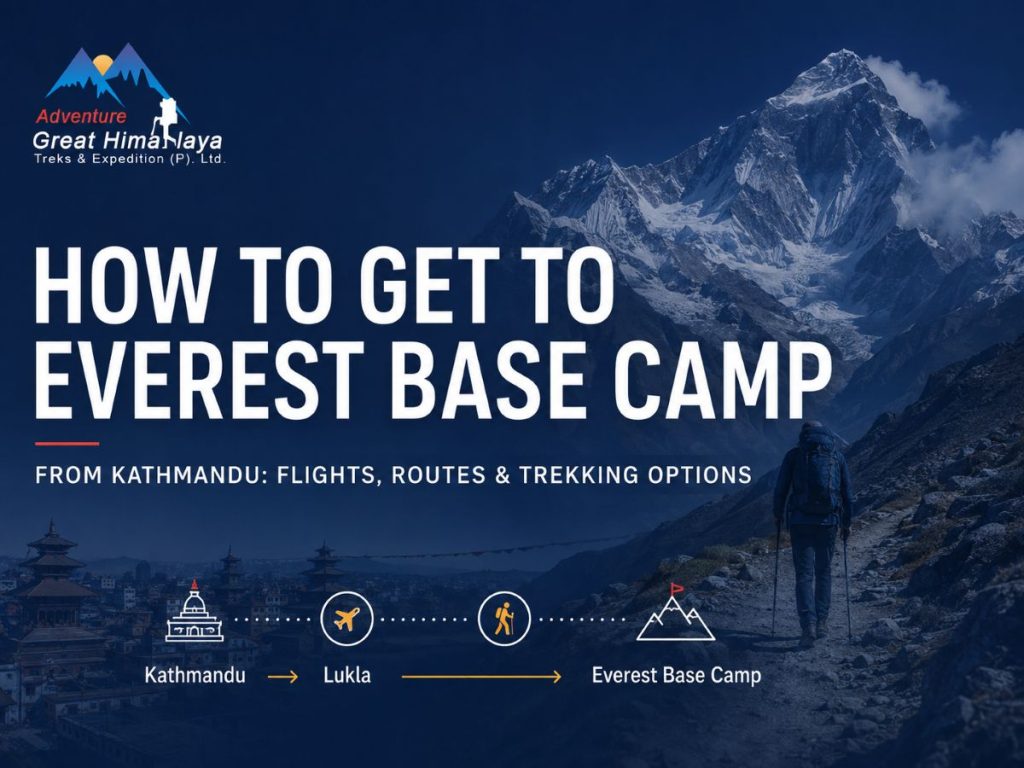
Everest Base Camp trekking is not merely reaching the foot of the world’s tallest peak. It’s trekking through Nepal’s Khumbu region, where the terrain transforms from the hustle and bustle of Kathmandu city to village life, suspension bridges, monasteries, glaciers, and awe-inspiring Himalayan summits. Most people start their Everest trek with a 30-40-minute flight from Kathmandu to Lukla, which lies in the heart of the Everest region, and then continue on foot along the Khumbu Valley.
The trekking path starts in Lukla and passes through Phakding and Namche Bazaar, then continues to Tengboche, Dingboche, Lobuche, and Gorak Shep. With increasing altitude, the surroundings change, and the effects of altitude become noticeable. The importance of acclimatization is especially evident in Namche Bazaar and Dingboche, making it an important element of itinerary planning.
However, for a first-time trekker, the list of consideration factors includes much more than just the route. Flight conditions, weather, trekking duration, permits, gear, acclimatization, and physical training are among the factors that can affect your journey to Everest Base Camp. While the classical route starts with a flight to Lukla, other alternatives, such as the Jiri route, are also possible. This guide will provide you with information on how to reach Everest Base Camp from Kathmandu and describe the route and other alternatives.
How Do You Get to Everest Base Camp?
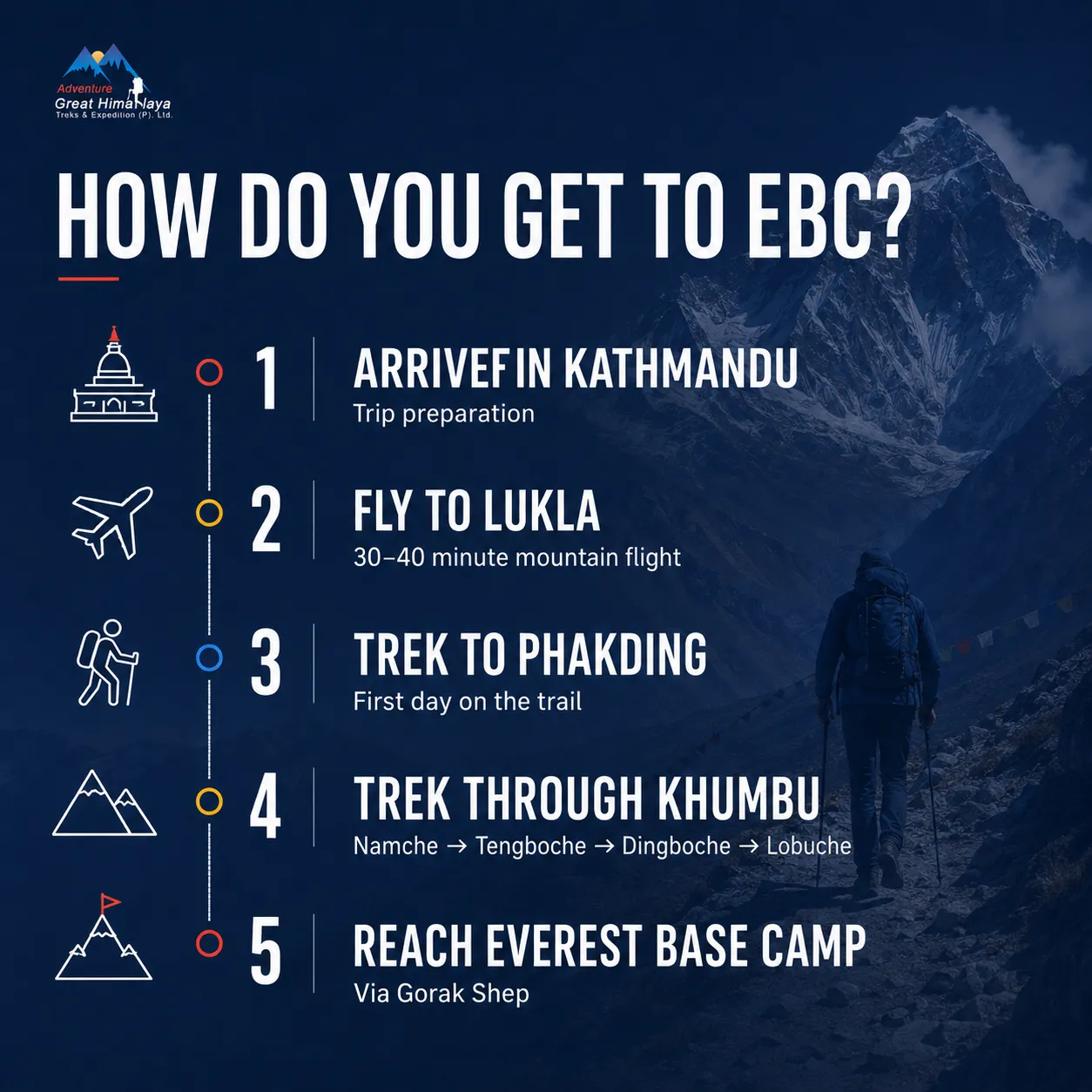
Most of the trekkers can reach Everest Base Camp by flying to Lukla from Kathmandu, then trekking through the Khumbu region. The classic Everest Base Camp route begins with a scenic flight to Lukla, then continues with a trek through numerous Sherpa settlements. The trekking route passes through Phakding, Namche, Tengboche, Dingboche, Lobuche, and Gorakshep before reaching Everest Base Camp.
The journey to the EBC depends on the itinerary, with the standard itinerary taking around 14 days from Kathmandu. After a 30-40-minute flight to Lukla, the path follows the Dudh Koshi River and gradually climbs towards the Himalayas. Also, a typical itinerary includes two acclimatization stops in Namche and Dingboche. The acclimatization days include hikes at higher elevations to adapt the body to low oxygen levels and prepare for the following days of walking at high altitude. Here are the steps on how to get to EBC:
Step 1: Travel to Kathmandu
First off, you will need to reach Kathmandu to begin the journey towards the Khumbu region. From Kathmandu, you will depart on a small aircraft from the Tribhuvan International Airport and land on the Tenzing Hillary Airstrip of Lukla. The flight takes 30-40 minutes and depends heavily on stable weather conditions for takeoff. Many trips also include one or two days in Kathmandu, which are allocated for trip preparation, equipment purchases, and permit applications.
Step 2: Arrival at Lukla
After the thrilling flight to Lukla, trekkers reach Tenzing-Hillary Airport (2,860 m / 9,383 ft), also known as Lukla Airport. Then, trekkers spend an hour or so on baggage preparation and a tea break. They meet their crew members in Lukla, including the guide and porter. Then, the official trek to the Khumbu region begins.
Step 3: Start Trekking From Lukla
Trekkers now begin their trek into the heart of the Khumbu Valley. Most of the itinerary begins with an overnight stop in Phakding, at an elevation of 2,610 meters (8,563 feet). Phakding is at a lower elevation than Lukla, so it is one of the best options for acclimatizing and getting accustomed to the accommodations of the Everest Region. Phakding lies along the Dudh Koshi River and gives a gentle introduction to the terrain of Everest.
Step 4: Trek Through the Khumbu Valley
After the overnight stay in Phakding, the trek begins towards the Everest Base Camp. While trekking for multiple days and passing numerous villages, trekkers will finally arrive at the base of Everest. The standard route follows the trek from Phakding to Namche Bazaar. In Namche, trekkers will spend an additional day acclimatizing. During acclimatization day in Namche, trekkers will hike towards the Everest View Hotel, which provides the first view of Everest on a clear day. Then, from Namche, trekkers will head to Tengboche and then to Dingboche. Dingboche marks the second acclimatization place where trekkers will hike to Nangkarkhatsang Viewpoint. With an additional day in Dingboche, the route moves towards Lobuche, Gorakshep, and finally to Everest Base Camp.
Step 5: Return From Everest Base Camp
After reaching the final destination at Everest Base Camp, the return journey commences. Trekkers will retrace their steps back to Gorakshep and then descend to Pheriche. From Pheriche, they will come to Namche and ultimately to Lukla. After reaching Lukla, trekkers will take a flight back to Kathmandu, which ends the Everest Base Camp trek.
Kathmandu to Everest Base Camp: Complete Route
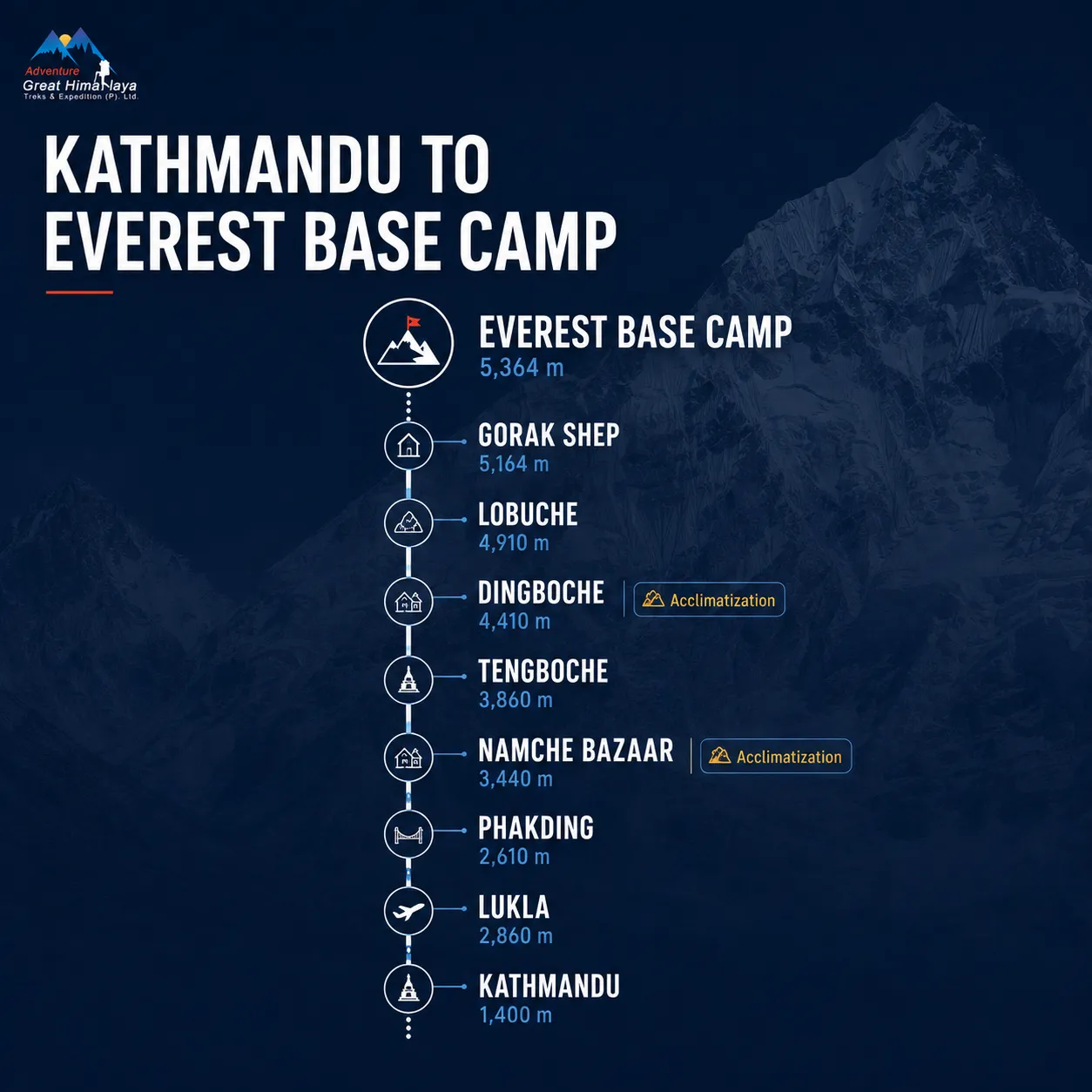
The table below summarizes the full journey stage by stage, including approximate trekking times and elevations. It is worth studying this table closely, as it shows something important about the trek: the daily distances are often modest, but the cumulative elevation gain over the entire route is significant. This is exactly why the itinerary includes built-in acclimatization days rather than pushing straight through to Base Camp.
| Day | Route | Approx. Time | Elevation |
| 1 | Arrival in Kathmandu | N/A | 1,400 m |
| 2 | Trek from Kathmandu to Lukla | 30–40 min flight | 2,860 m |
| 3 | Trek from Lukla to Phakding | 3-4 hrs. | 2,610 m |
| 4 | Trek from Phakding to Namche Bazaar | 5-7 hrs. | 3,440 m |
| 5 | Acclimatization in Namche (Hike to Everest View Hotel) | 1 day | 3,440 m |
| 6 | Trek from Namche to Tengboche | 5-6 hrs. | 3,860 m |
| 7 | Trek from Tengboche to Dingboche | 5-6 hrs. | 4,410 m |
| 8 | Acclimatization in Dingboche (Hike to Nangkarkhatshang Viewpoint) | 1 day | 4,410 m |
| 9 | Trek from Dingboche to Lobuche | 4-5 hrs. | 4,910 m |
| 10 | Trek from Lobuche to Gorak Shep | 3-4 hrs. | 5,164 m |
| 11 | Trek from Gorak Shep to Everest Base Camp | 5-7 hrs. round trip | 5,364 m |
| 12 | Return Journey Begins from Gorak Shep to Lukla | Several trekking days | 2,860 m |
Note: These are approximate trekking times only. Actual duration depends on the specific itinerary, acclimatization needs, weather conditions, and the pace of the group.
Where Does the EBC Trek Start?
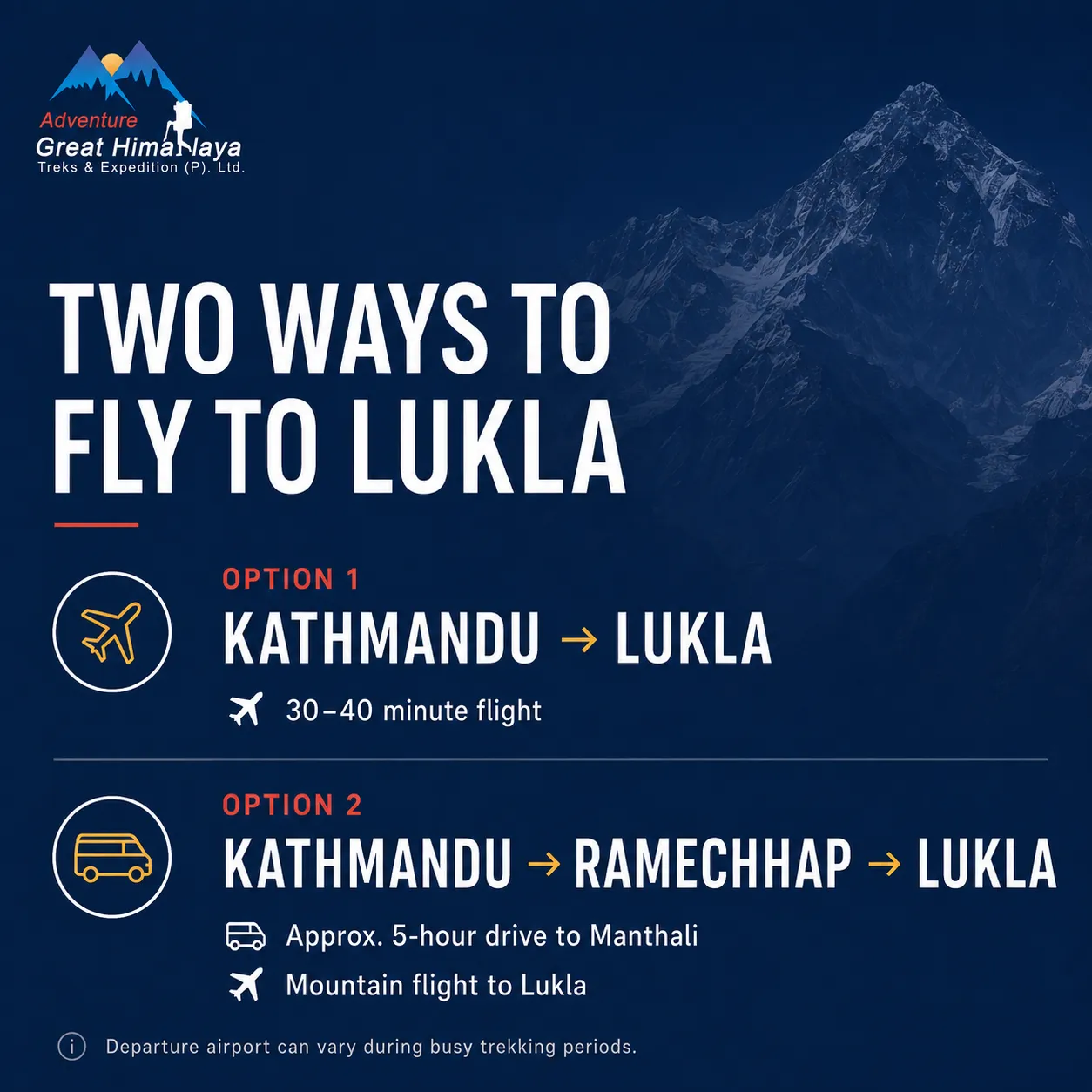
The traditional route to the Everest Base Camp starts in Kathmandu; this is the primary entry point for trekkers traveling to Nepal. However, the actual Everest Base Camp trek on foot starts from Lukla, a mountain town in the Khumbu region at around 2,860 m (9,383 ft). To reach Lukla, trekkers must take a flight. Depending on weather and flight schedules, flights can alternatively be scheduled from Ramechhap Airport where visitors travel by road from Kathmandu to Ramechhap and then board a flight to Lukla.
The flight from Kathmandu or Ramechhap to Lukla takes about 30-40 minutes and provides breathtaking views of Nepal’s hills and the Himalayan landscape if the weather is good. Lukla is well known for being the entry point to the Everest region; the town hosts its mountain airport, trekking lodges, shops, restaurants, and other facilities for trekkers and climbers visiting the area. The high altitude of Lukla and the mountain-town nature of the place create an obvious difference between the busy city of Kathmandu and the remote mountains of the Khumbu.
Once in Lukla, the route to the Everest Base Camp continues by foot, as trekkers use the existing trail going through the Khumbu Valley. The typical way to go through the area is by visiting Phakding, Namche Bazaar, Tengboche, Dingboche, Lobuche, and Gorak Shep en route to the Everest Base Camp that lies at 5,364 m (17,598 ft) above sea level. The gradual rise in elevation, as well as the planned acclimatization stops, are crucial aspects of the trek and allow trekkers to get used to progressively lower levels of oxygen.
Note: Lukla is a starting point for foot travel, not a town you can drive to. The airstrip is there because there is no practical road access to this section of the Khumbu, hence the flight is a key element of the trip.
Why Does the Everest Base Camp Trek Start in Lukla?
Lukla has become the starting point of the trek for several practical reasons:
- Airport access that connects directly to Kathmandu and the mountain flight network.
- It shortens the overall approach compared with older overland routes.
- Established trekking infrastructure built up over decades of expeditions.
- A wide network of teahouses and lodges along the trail.
- Ready access to porters and guides based in the area.
- Direct access to the main Khumbu trekking trail toward Namche Bazaar.
Kathmandu to Lukla Flight for the Everest Base Camp Trek
The flight to Lukla is the first and most important mode of transport on the trek, and it is important that the trekker plan accordingly, as it sets the tone for the rest of the trek. One of the most practical things a first-time trekker can do before leaving is to understand how this flight works and what can affect it, as the entire trek relies on it being on schedule.
How Long is the Kathmandu to Lukla Flight?
The flight takes approximately 30 to 40 minutes, subject to weather and operating conditions on the day of travel.
How Much Does the Kathmandu to Lukla Flight Cost?
The fare depends on the season, the airline, seat availability, government and airport charges, etc., so it is preferable to check actual prices directly with the airline or a trekking operator rather than relying on a fixed price.
Where Do You Fly From?
Depending on flight schedules and airport operations, flights to Lukla can depart from either Kathmandu or Ramechhap. The departure airport may change without prior notice, so please check the one closest to your travel dates. In the event of excessive crowds, the Kathmandu-to-Lukla flight may be diverted to Manthali, Ramechhap. In such cases, trekkers need to drive from Kathmandu to Manthali, which takes about 5 hours depending on road conditions.
Why Are Lukla Flights Sometimes Delayed?
Lukla airstrip is short and is located at a high altitude. The village itself is surrounded by mountainous terrain, making it extremely sensitive to weather conditions. Poor visibility, cloudy weather, strong winds, and rainfall make Lukla flight operations difficult. So, flights here operate under visual flight rules rather than instrument flight rules, meaning pilots need clear conditions to take off and land safely. Lukla is known for flight disruptions due to a combination of factors:
- Cloud cover over the mountains
- Fog, especially in the early morning
- Wind conditions at altitude
- Poor visibility for the short mountain runway
- Airport operating conditions and traffic
- Aircraft availability
Because of this, it is best to build one or two buffer days into your itinerary in case of flight delays. Also, it is advisable to check weather patterns before the flight to ensure a safe flight experience. It is better to book the Lukla flight or Everest Base Camp trekking package with a reliable trekking company like Adventure Great Himalaya who have active connection with the flight operators and can book your flight without a hassle. Also, trekkers are highly recommended to commence the Everest Base Camp trek during best seasons like Spring and Autumn where there is no weather obstruction for Kathmandu to Lukla flight.
Kathmandu to Ramechhap to Lukla
Many EBC travelers go to Ramechhap when Lukla flights are diverted from Kathmandu. The journey begins with a drive from Kathmandu to Ramechhap Airport, flying a flight from Manthali Ramechhap to Lukla, and then continuing the EBC Trek.
Why Do Some EBC Trekkers Travel Through Ramechhap?
Some trekkers may need to travel to EBC via Ramechhap due to limited flight availability and airport capacity in Kathmandu. This happens especially during peak trekking periods, when the Lukla flight crowd is at its peak. So, to prevent air traffic congestion, the Civil Aviation Authority of Nepal (CAAN) diverted flights to Lukla from Manthali, Ramechhap, instead of the standard route via Kathmandu. The relocation is temporary and is intended to manage the congestion.
How Far Is Ramechhap From Kathmandu?
Ramechhap is 132 kilometers (82 miles) away from Kathmandu, which requires a road trip. The road journey takes about 5 hours, depending on the route and traffic conditions. The drive usually begins early in the morning to match the flight schedule. In some cases, trekkers drive to Manthali, spend a night, and begin the flight the next morning.
Is Ramechhap Better Than Kathmandu for the EBC Trek?
It is not accurate to describe Ramechhap as “better.” It is generally an operational alternative used when flight scheduling requires it, rather than a different trekking route or experience once you reach Lukla.
Lukla to Everest Base Camp: The Trekking Route
This section takes you on the classic path in the order that most trekkers take it, starting from the very beginning at Lukla and ending at Base Camp. The character of each stage varies with altitude, vegetation, and the increasing scale as the surrounding peaks approach.
Lukla to Phakding
The first day is a relatively easy day on the trail, following a short distance and a low elevation gain in a few hours. The scenery features pine forests and river valleys, and for most trekkers, this is their first time walking in the Khumbu.
Phakding to Namche Bazaar
This stage includes several notable features:
- Crossings of the Dudh Koshi River
- A series of suspension bridges
- Entry into Sagarmatha National Park
- The first major sustained ascent of the trek
- Arrival in Namche Bazaar, the main trading hub of the Khumbu
Namche Bazaar to Tengboche
The early mountain vistas here are among the best, offering views of Everest and the majestic Ama Dablam before reaching Tengboche and its famous monastery. The trail is a favorite day for many trekkers, as it passes through forests and open ridgelines, offering views of the surrounding peaks.
Tengboche to Dingboche
As the trail continues, vegetation thins noticeably, and the altitude increases, marking the transition into higher, more exposed terrain. Trees give way to shrubs and then to the open, rocky landscape that characterizes the upper Khumbu, and the change in scenery is a useful visual reminder of how much elevation has already been gained.
Dingboche to Lobuche
This stretch of the trek includes:
- Increasingly high-altitude, open landscape
- Memorials to climbers who lost their lives on Everest
- Views of the Khumbu Glacier
- The Thukla Pass area, a notable climb along the way
Lobuche to Gorak Shep
The landscape becomes increasingly barren and rocky, and the air noticeably thinner as trekkers approach Gorak Shep, the last settlement before Base Camp.
Gorak Shep to Everest Base Camp
Gorak Shep serves as the final overnight settlement before Base Camp on the standard route, and most trekkers set out from here for the final push to EBC.
Everest Base Camp to Gorak Shep
After reaching Base Camp, trekkers generally return to Gorak Shep to sleep rather than staying overnight at Base Camp itself.
Can You Drive to Everest Base Camp?
No, you can’t drive directly to Everest Base Camp. The classic Everest Base Camp route is a trekking route, and there are no vehicles to Base Camp. This is one of the things that is often confusing to first-time visitors, particularly because so much of modern travel is done by road, which goes almost anywhere else.
A few points are worth clarifying:
- Roads exist in parts of the broader Everest region.
- The classic EBC trail remains a walking route from Lukla onward.
- The presence of roads elsewhere does not eliminate the high-altitude trekking section of the journey.
Can You Go to Everest Base Camp Without Flying to Lukla?
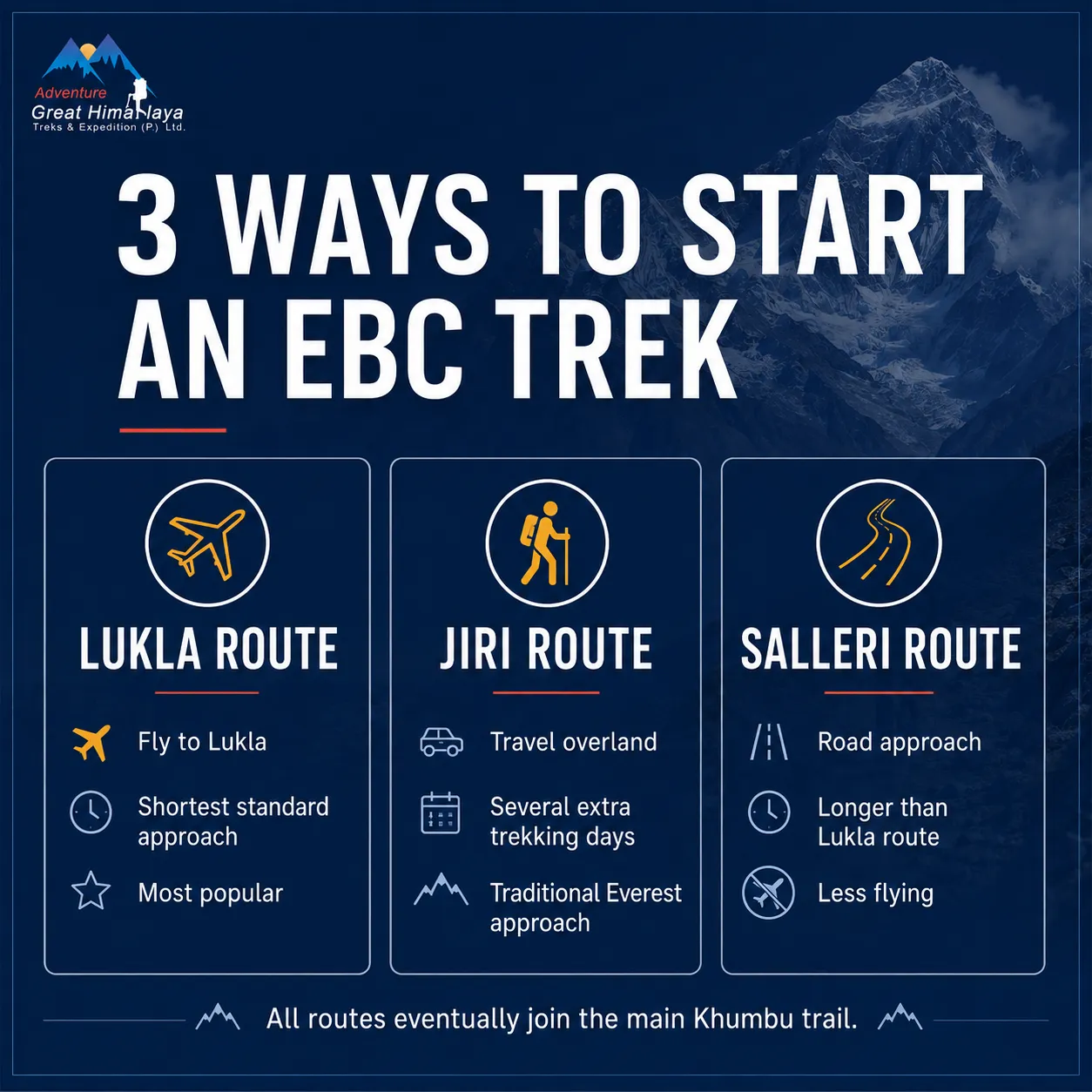
Yes, there are alternative overland approaches for travelers who prefer not to fly into Lukla, such as the Jiri-to-Everest Base Camp or Salleri-to-Everest Base Camp routes.
Jiri to Everest Base Camp
The Jiri Route has a long history as the overland route to Everest Base Camp, used for Everest expeditions before Lukla became an important entry point to the area. The trip starts in Jiri and follows a traditional hill and Sherpa-village route through Shivalaya, Bhandar, Sete, Junbesi, Nunthala, and Bupsa, ending at the main Everest trekking trail in Phakding. After that, the trekking path continues through Namche Bazaar, Tengboche, Dingboche, Lobuche, and Gorak Shep and ends up at Everest Base Camp. The Jiri Route takes a few days longer than the Lukla Route, and the trekkers have to climb and descend more frequently through the lower Solu region.
Salleri to Everest Base Camp
Road transport to Salleri may shorten the journey from Jiri, but it still involves considerable trekking afterward. Road access to this area can vary, so please check if you are planning to use this route.
Is the Jiri/Salleri Route Better Than Lukla?
Rather than being simply “better” or “worse,” the two options suit different priorities:
| Feature | Lukla Route | Jiri/Salleri Route |
| Trek duration | Shorter | Longer |
| Road travel | Minimal | More |
| Acclimatization | Planned rest days | More gradual approach |
| Scenery | Excellent | More diverse |
| Walking | Less | More |
| Best for | Standard EBC trek | Extended trekking experience |
Can You Reach Everest Base Camp by Helicopter?
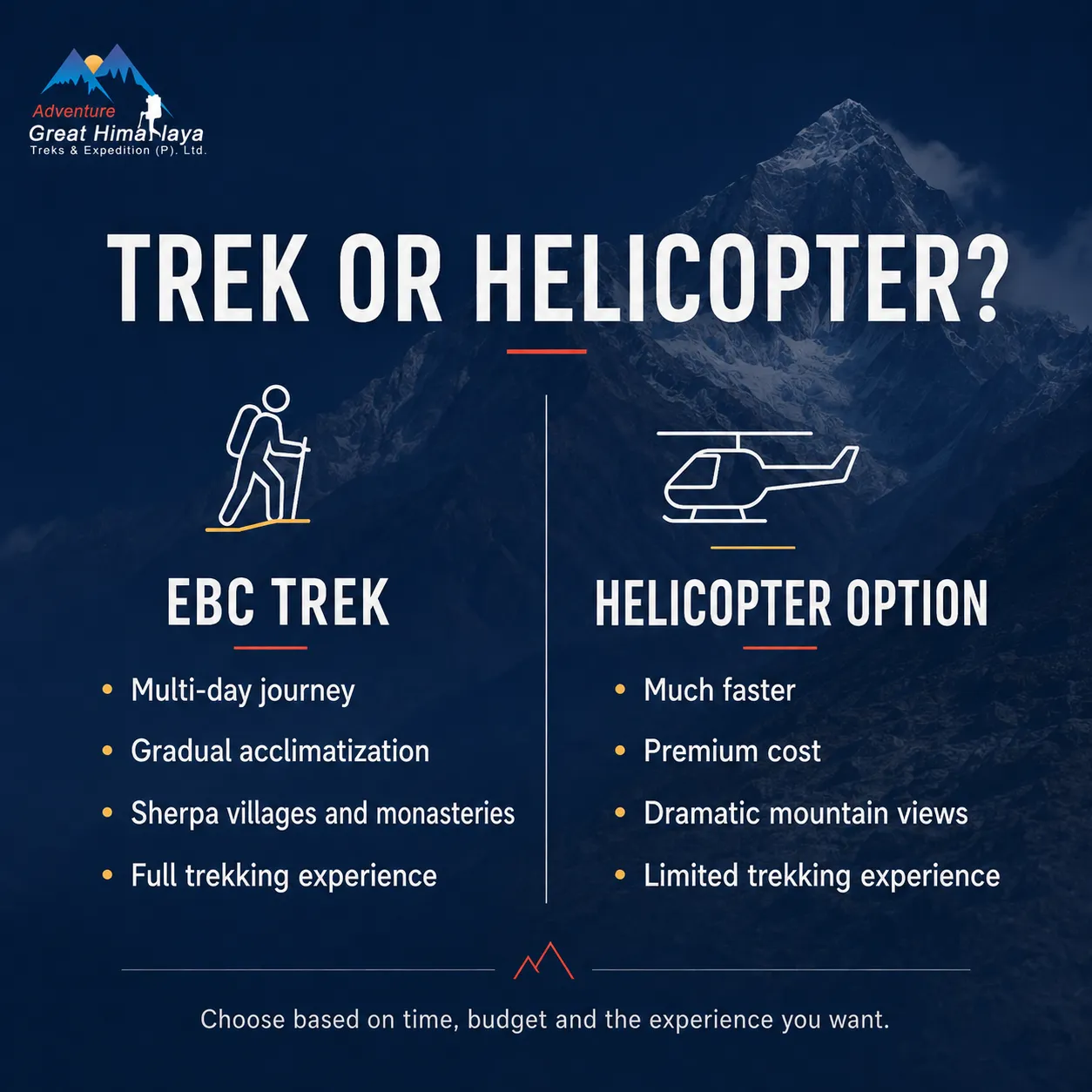
Helicopters are a visible part of daily life in the Khumbu, and it is natural for travelers to wonder whether they offer a shortcut to Base Camp. The honest answer is more nuanced than a simple yes or no, and it helps to distinguish between several different helicopter-related options in the Everest region:
- Helicopter sightseeing flights over the region.
- Helicopter-assisted trekking, combining flights with some walking.
- Helicopter evacuation, used for emergencies rather than standard travel.
- Landing near or at Base Camp under specific circumstances.
A helicopter flight is not equivalent to completing the EBC trek, since the trekking experience itself, the villages, acclimatization, and gradual ascent are a large part of what the journey involves.
Can You Fly Directly From Kathmandu to Everest Base Camp?
Regular commercial flights do not go directly from Kathmandu to Everest Base Camp. Helicopter operators may offer sightseeing routes or charter arrangements into the region, but this is different from a scheduled direct flight to Base Camp.
Is a Helicopter Flight to Everest Base Camp Worth It?
Yes, a helicopter flight to Everest Base Camp is worth it if you want to skip the hassle of flying to Lukla or do not want to trek to Everest Base Camp. The helicopter flight is a luxurious option that can be expensive compared to the standard flight; however, it can save you time and allow for an adventurous option to see Mount Everest. Here are some of the points to consider:
- Time saved compared with a multi-day trek.
- Cost, which is typically much higher than trekking.
- Access to dramatic mountain views.
- Sudden altitude exposure without a gradual ascent.
- A limited trekking experience compared with walking the full route.
- Weather restrictions that can affect helicopter operations.
However, it is necessary to understand that helicopters are not permitted to land at Everest Base Camp and must land at Kalapatthar. Kalapatthar (5,545 m) is a vantage point offering the best view of Everest. If you are considering taking a helicopter flight and do not want to trek to the EBC, then you will reach Kalapatthar. The Everest View is better from Kalapatthar, but you will not get the glory of clicking photographs on the iconic rock situated at Everest Base Camp.
How Many Days Does It Take to Get to Everest Base Camp?
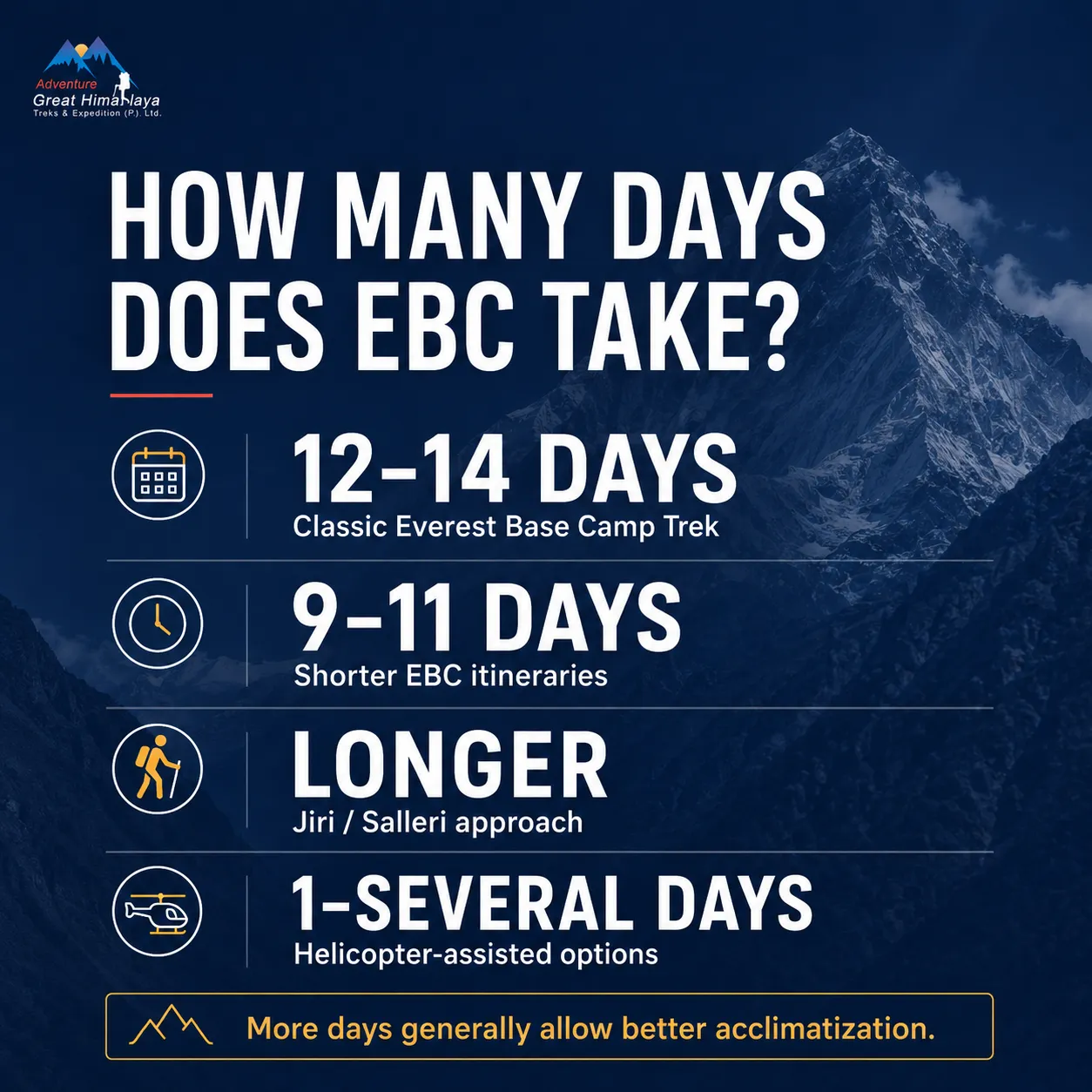
A standard itinerary generally takes approximately 12 to 14 days round trip from Kathmandu, depending on the itinerary and acclimatization schedule.
| Itinerary Type | Approx. Duration | Best For |
| Classic EBC | 12–14 days | Most trekkers |
| Short EBC | 9–11 days | Experienced trekkers with limited time |
| Jiri/Salleri EBC | Longer | Extended trekking |
| EBC + Kala Patthar | 12–14+ days | Mountain views and photography |
| Helicopter-assisted | 1–several days | Time-limited travelers |
Note: Shorter itineraries are not automatically the better choice. Cutting days out of the schedule usually means less time for acclimatization, which increases the risk of altitude-related illness.
How Difficult Is the Journey to Everest Base Camp?
Getting to EBC requires a good level of physical fitness. While the trek itself is moderately challenging, trekkers do need to walk multiple days on uneven mountain terrain. Trekkers need to walk at least 6 hours per day during the journey, so the trek does demand some level of physical fitness. Also, trekking towards the Everest Base Camp is not a luxury holiday; the area is remote and equipped with basic facilities. While lower settlements have become sophisticated, the high altitude region, like Lobuche and Gorakshep still lack basic infrastructure.
Likewise, weather and altitude play a vital role in the difficulty of the trek. Trekkers reach an altitude of 5,364 meters where there are chances of altitude sickness. At that altitude, besides the sickness, the temperature is below the freezing point, and basic work like walking can be difficult. However, with good preparation, hydration, acclimatization, and physical fitness, the trek can be completed. Key factors include:
- Long-distance walking over multiple consecutive days.
- Steep ascents and descents on rocky trails.
- High altitude and the effects of thinner air.
- Cold temperatures, especially at higher elevations.
- Thin air that makes exertion feel harder than at sea level.
- Variable and sometimes unpredictable mountain weather.
- Several consecutive trekking days with limited rest.
Is Everest Base Camp Suitable for Beginners?
Yes, the Everest Base Camp trek is suitable for beginners. You do not need prior mountaineering expedition experience to reach Base Camp. Many first-time trekkers have completed the route each year. The thing that matters the most is not brute force but preparation and pacing. Conditions that help beginners succeed include:
- Reasonable overall fitness going into the trek.
- Proper acclimatization built into the schedule.
- An appropriate, realistic itinerary.
- Support from a professional guide or trekking team.
- Preparation for the effects of altitude.
Why Acclimatization Matters on the Way to EBC
Scheduled rest days (Namche Bazar, Dingboche) allow the body to acclimatize to the lower oxygen levels at higher altitudes. Avoiding or rushing these days can greatly increase the chances of getting altitude sickness.
What Is the Best Way to Get to Everest Base Camp?
There is no single “best” route to EBC, which is suitable for all. The decision will depend on how much time you have, how much hiking you really want to do, how you feel about flying to a small mountain airstrip, and how important it is to you to take a slow and steady route to altitude. The table below provides a correlation between common priorities and the route that is most likely to meet the priority.
| Your Priority | Best Option |
| Classic EBC experience | Kathmandu to Lukla then Trek |
| Limited time | Lukla with a shorter itinerary, or a helicopter-assisted option |
| More gradual trekking | Jiri/Salleri approach |
| Avoid flying to Lukla | Overland plus trekking approach |
| Maximum mountain views | Classic EBC combined with Kala Patthar |
| First-time trekker | Standard, well-acclimatized itinerary |
| More solitude | Shoulder or off-season route timing |
What Permits Do You Need to Get to Everest Base Camp?
It’s not simply a matter of showing up and beginning to walk to reach Everest Base Camp. The Khumbu is a protected area and trekkers must have the appropriate documentation before travelling in this region. Permit requirements may vary from year to year, so it is advisable to check current permit requirements as close to your travel dates as possible, but for those planning to visit Everest Base Camp, permits are currently required and may include the following:
- Sagarmatha National Park Entry Permit
- Khumbu Pasang Lhamu Rural Municipality permit
- Current TIMS or guide requirements, which may be updated from time to time
For full details on costs, where to obtain these permits, and current guide requirements, see our dedicated guide: Everest Base Camp Trek Permit, TIMS and Guide Requirements.
What Should You Pack for the Journey to Everest Base Camp?
A well-prepared kit makes a significant difference on the trail, particularly as temperatures drop and conditions become more variable at higher elevations. Packing well is less about bringing everything possible and more about layering effectively and preparing for both cold and sun exposure. Core items include:
- Down jacket
- Sleeping bag rated for cold conditions
- Waterproof jacket
- Trekking boots
- Gloves
- Thermal base layers
- Sunglasses
- Sunscreen
- Water bottle
- Headlamp
- Personal medication
- Basic first-aid supplies
For a complete list with more detail, see our Everest Base Camp Trek Packing List.
Best Time to Travel to Everest Base Camp
Seasonal conditions play a major role in shaping the experience of the trek, affecting everything from trail visibility and temperature to the reliability of flights in and out of Lukla. Choosing the right season can make the difference between clear mountain panoramas and days spent walking through clouds.
| Season | Conditions | Recommendation |
| Spring | Stable, warming temperatures, flowers in bloom | Excellent |
| Monsoon | Rain and cloud, frequent flight disruptions | Challenging |
| Autumn | Clear, dry, and stable weather | Best overall |
| Winter | Very cold, with snowy and icy trail conditions | Experienced trekkers |
For a month-by-month breakdown, see our Everest Base Camp Weather and Temperature by Month guide.
Everest Base Camp Temperature
| Season | Daytime Temperature at EBC | Nighttime Temperature at EBC | Conditions | Trekking Suitability |
| Spring (Mar–May) | Around -5°C to 5°C | Around -10°C to -15°C | Warming conditions, generally clear skies, and rhododendrons in bloom at lower elevations | Excellent |
| Monsoon (Jun–Aug) | Around 0°C to 5°C | Around -5°C to -10°C | Rain and cloud at lower elevations, reduced mountain visibility, and possible flight disruptions | Challenging |
| Autumn (Sep–Nov) | Around -5°C to 5°C | Around -10°C to -15°C | Clear skies, dry conditions, and excellent mountain visibility | Best overall |
| Winter (Dec–Feb) | Around -10°C to 0°C | Around -15°C to -20°C or lower | Very cold conditions with possible snow and icy trails | Experienced trekkers |
Frequently Asked Questions
How do you get to Everest Base Camp?
Most trekkers fly in from Kathmandu and then trek for approximately 11 to 14 days through the Khumbu Valley, stopping at Namche Bazaar, Tengboche, Dingboche, Lobuche, and Gorak Shep before reaching Base Camp on foot.
How do I get to Everest Base Camp from Kathmandu?
The standard route is Kathmandu to Lukla or Ramechhap then trek towards Everest Base Camp, following the Khumbu Valley trail on foot from Lukla.
How do you get to Mount Everest Base Camp?
The normal route is to fly to Lukla and then trek along the well-established trail in the Khumbu Valley, which is used by most expeditions and trekking groups.
How do you go to Everest Base Camp without flying?
For those who don’t wish to fly, there are the Jiri or Salleri routes, which involve a lot more trekking days before you reach the main Khumbu trail and a lot more overland travel.
Where does the EBC trek start?
The standard EBC trekking route begins in Lukla, the gateway town for the Khumbu region. To reach Lukla, trekkers need to either take a flight from Kathmandu or Ramechhap. However, for a longer approach trekkers can reach Lukla through a drive from Salleri or Jiri route.
How long does it take to get to Everest Base Camp?
A typical round-trip itinerary from Kathmandu takes approximately 12 to 14 days. A standard 12 days EBC itinerary includes:
Day 1: Fly to Lukla and trek to Phakding
Day 2: Trek from Phakding to Namche Bazaar
Day 3: Acclimatization Day in Namche Bazaar
Day 4: Trek from Namche Bazaar to Tengboche
Day 5: Trek from Tengboche to Dingboche
Day 6: Acclimatization Day in Dingboche
Day 7: Trek from Dingboche to Lobuche
Day 8: Trek from Lobuche to Everest Base Camp via Gorak Shep
Day 9: Hike to Kala Patthar and trek to Pheriche
Day 10: Trek from Pheriche to Namche Bazaar
Day 11: Trek from Namche Bazaar to Lukla
Day 12: Fly from Lukla to Kathmandu/Ramechhap
Can you drive to Everest Base Camp?
No you cannot drive to Everest Base Camp. There is no direct road access to Base Camp, and the final stretch of the journey must be completed on foot.
Can you fly directly to Everest Base Camp?
There are no regular commercial flights that serve Base Camp. There are also helicopter sightseeing or charter options, but these are different from a scheduled direct flight.
Can you trek to Everest Base Camp from Jiri?
Yes, you can trek from Jiri to Everest Base Camp. However, it is a considerably longer approach than the standard Lukla route which can take additional 5 days just to reach Lukla and begin the trekking journey.
Can beginners trek to Everest Base Camp?
Yes, provided there is adequate preparation, proper acclimatization, and appropriate support along the way.
Is Lukla the only way to get to Everest Base Camp?
No. Alternative overland approaches, such as the Jiri or Salleri routes, offer a different, more gradual way to reach the region.
What is the easiest way to get to Everest Base Camp?
This depends on what “easiest” means to the traveler. Whether that is the least amount of trekking, the shortest overall itinerary, or the most gradual approach to altitude. The easiest way to get to Everest is through a helicopter flight, which omits the hassle of trekking for multiple days. But if you want to trek to the EBC, starting with a flight to Lukla is the easiest approach.
Conclusion
The trip to Everest Base Camp goes beyond just getting there. Not only does the gradual process of reaching Everest via the beautiful Khumbu valley and Sherpa villages, monasteries, glaciers, and stunning scenery create an experience in itself, but it also gives you some time for rest. There are different routes for EBC treks, including the most common Lukla route and the Jiri and Salleri routes.
Several factors contribute to the success of an EBC trek, including acclimatization, physical condition, appropriate equipment, and potential changes in flight schedules. So, keeping these factors in mind, trekkers should plan their adventure to the Everest Base Camp. If you are ready to plan your Everest Base Camp adventure, then explore our EBC trekking itineraries, or contact Adventure Great Himalaya for a customized itinerary tailored to your available time, preferred route, and travel dates.
Speak to our local travel expert, who can assist you in planning your trip.
PLAN YOUR TRIP Friday, September 18th, 2026
Top 10 Best Trekking Operators in Kathmandu, Nepal
 Friday, September 18th, 2026
17+ Best Things to Do in Kathmandu, Nepal
 Sunday, September 6th, 2026
Annapurna Base Camp Trek from Pokhara
 Wednesday, September 2nd, 2026
Best Everest Three Pass Trek Company in Nepal
 Tuesday, September 1st, 2026
26 August 2026 Nepal-Tibet Border Flash Flood
 Tuesday, September 1st, 2026
How to Get to Everest Base Camp from Kathmandu?
 Monday, August 31st, 2026
Everest Base Camp Trek Permit, TIMS & Guide Requirements
 Thursday, May 7th, 2026
Manaslu Trek Routes Guide
 Thursday, June 11th, 2026
Is Nepal Safe for Tourists? Travel Safety Guide
 Thursday, June 11th, 2026
Spiritual Travel in Nepal: A Guide for Seekers
 Monday, April 27th, 2026
Manaslu Trek Booking with Tour Guide Vs Agency
 Sunday, April 19th, 2026
10 Reasons You Should Hike Annapurna Circuit
 Tuesday, July 7th, 2026
Best Everest Three Pass Trek Company
 Saturday, July 11th, 2026